
Does Fat Store Toxins? What Science Says About Chemicals, Fat Loss, and Metabolism
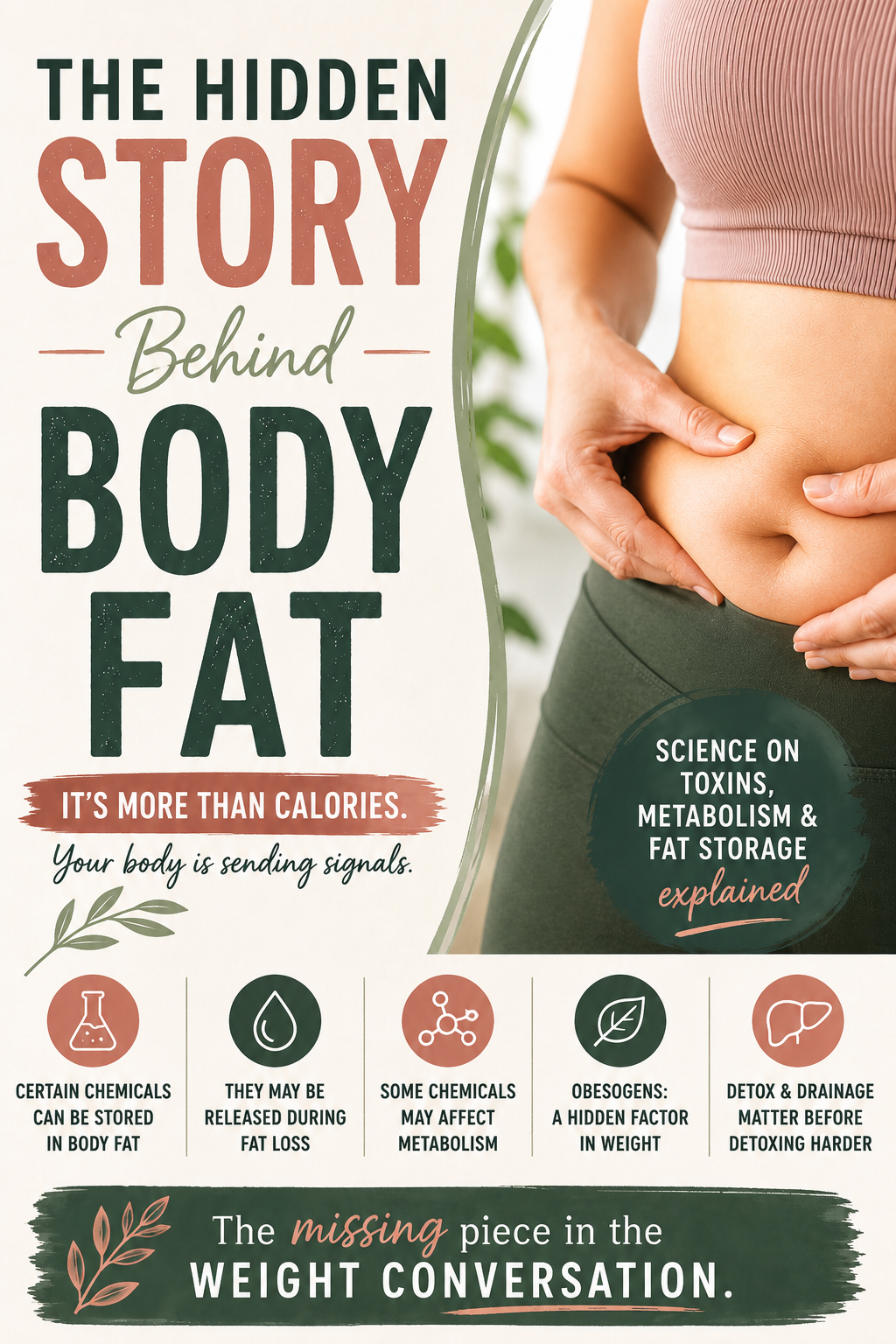
Body fat is not just stored calories. Certain chemicals may collect in fatty tissue, and some may shift when fat breaks down. This article explains why metabolism is more than calories, why detox and drainage matter, and how to think about toxic load without fear or body shame.
Body fat is usually talked about like it is nothing more than stored calories.
Eat too much, store fat.
Eat less, burn fat.
Simple, right?
Except the body is not simple.
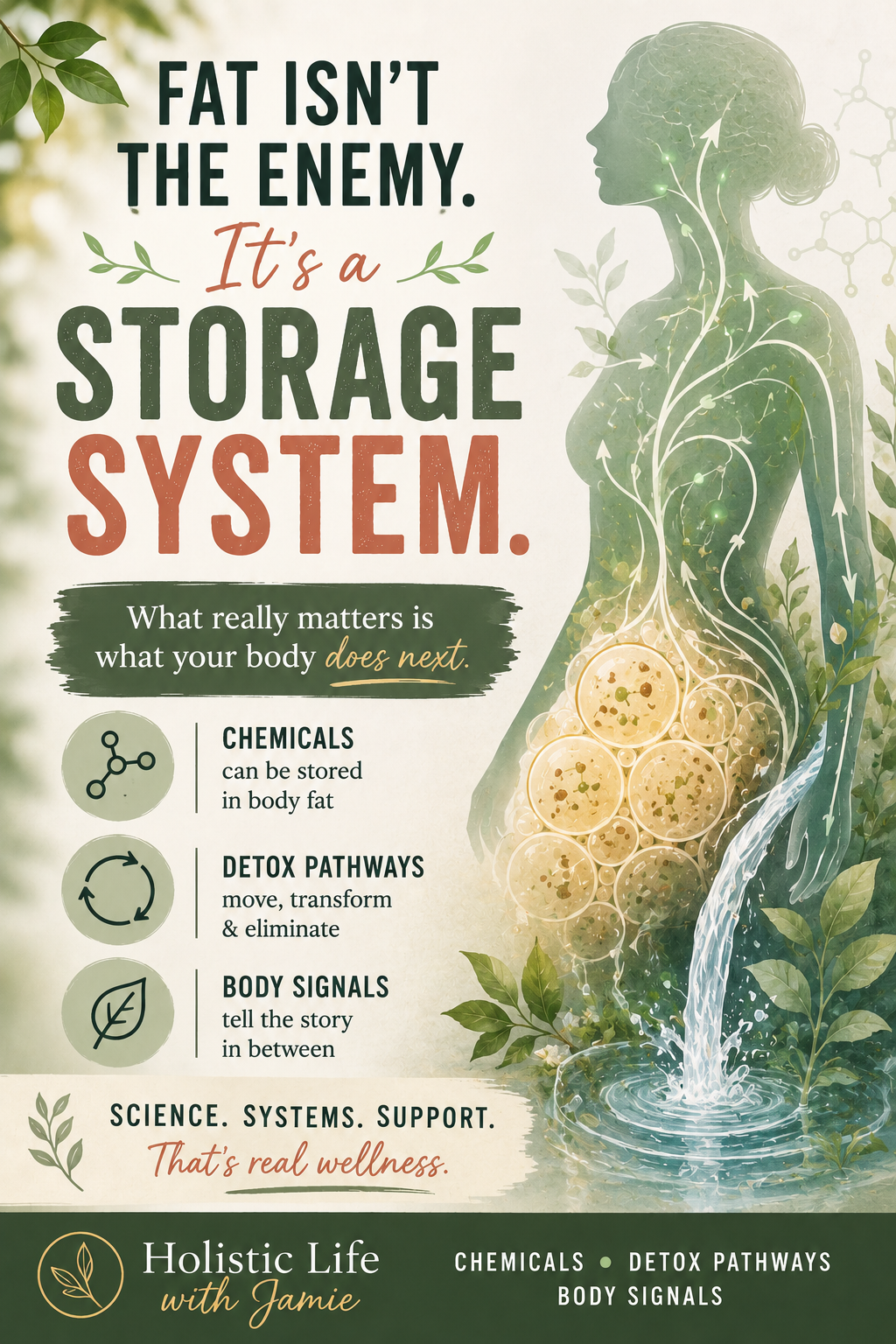
Fat is living tissue. It stores energy, communicates with hormones, affects inflammation, and may also hold certain chemicals the body cannot easily break down or remove.
That changes the conversation.
For a long time, the calorie explanation made sense to me too. But the more I learned about the body, and the more I listened to real people describe what was happening in their own bodies, the less complete that explanation felt.
In my nursing career, I have heard people say many times, “I barely eat anything, and I still can’t lose weight.”
That statement does not prove calories do not matter.
But it does make the calorie-only explanation feel painfully incomplete.
If fat tissue can store certain chemicals, and if certain chemicals can affect metabolism, insulin, hormones, and fat-cell behavior, then maybe fat storage deserves a deeper conversation.
Not a shame conversation.
Not a “detox your way skinny” conversation.
A systems conversation.
This is not about blaming your body.
Fat is not dirty, bad, or proof that someone has failed. This is about understanding how fat tissue works, how certain chemicals behave, and why metabolism is more complex than calories, discipline, or willpower.
Does fat store toxins?
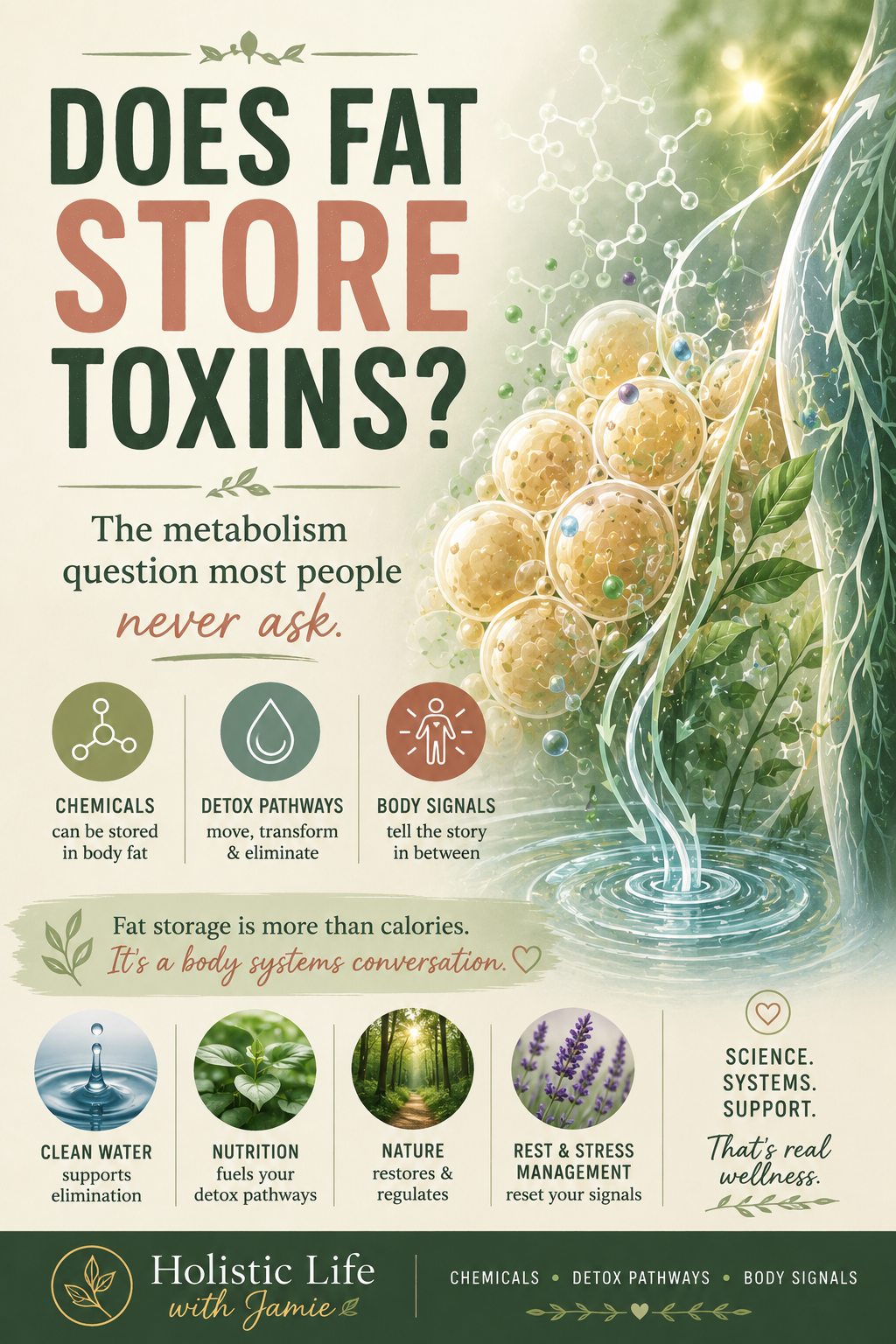
Yes, certain chemicals can collect in body fat because they dissolve more easily in fat than in water. These are often called fat-soluble chemicals. Some persistent organic pollutants, or POPs, can build up in fatty tissue and may move back into circulation when fat is broken down.
Are toxins released during fat loss?
Some research suggests certain stored chemicals may increase in the bloodstream during weight loss. This does not mean fat loss is bad or dangerous. It means the body may need support for normal detox, drainage, digestion, liver function, bile flow, minerals, and elimination while fat is changing.
Can toxins cause weight gain?
It is too simple to say toxins cause weight gain. But research on obesogens suggests some chemicals may affect fat storage, insulin signaling, hormone communication, and metabolism. Obesity is not just a willpower issue. It is a systems issue, and environmental exposure may be one overlooked piece.
What are obesogens?
Obesogens are chemicals that may interfere with how the body stores fat, regulates metabolism, handles insulin, or forms fat cells. The term does not mean every weight issue is caused by chemicals. It means some environmental exposures may influence the systems that help regulate weight and metabolic health.
In This Article
You’ll learn:
- Whether body fat can store certain chemicals
- What POPs are and why they matter
- Whether toxins can be released during fat loss
- What obesogens are and how they may affect metabolism
- Why fat storage is not just a calorie conversation
- Why drainage and elimination matter before “detoxing harder”
- How to reduce toxic load without turning your life into a fear-based scavenger hunt
Does fat store toxins?
Yes, certain chemicals can be stored in body fat because they dissolve more easily in fat than in water. These are often called fat-soluble chemicals. Some persistent organic pollutants, or POPs, can collect in fatty tissue and may be released back into circulation when fat is broken down.
This is where the conversation has to slow down and get precise.
Not every “toxin” is stored in fat. Not every weight issue is caused by toxins. And fat itself is not bad, dirty, or something to be ashamed of.
But body fat is also not dead storage.
Fat is living tissue. It stores energy, communicates with hormones, influences inflammation, and may also act as a storage space for certain chemicals the body cannot easily break down or remove. Researchers have described adipose tissue as a place where persistent organic pollutants can accumulate, and also as a tissue that may influence how those chemicals affect the body.
What most people think:
Fat is just extra calories sitting on the body.
What’s actually happening:
Fat is active tissue that participates in energy storage, hormone signaling, inflammation, and chemical storage.
This matters because it changes the question.
Instead of only asking, “How do I burn fat faster?” we may need to ask a better question:
What is my body storing, why is it storing it, and are my elimination pathways ready for what gets released?
That is why this topic belongs inside the bigger Detox & Drainage conversation, not the shame-soaked weight-loss conversation.
If fat tissue can hold certain chemicals, then fat loss is not just a math problem. It is also a systems problem.
And systems need support, not punishment.
What chemicals are stored in body fat?
The chemicals most often discussed in fat storage are long-lasting chemicals that dissolve more easily in fat than water. Scientists often call some of these chemicals persistent organic pollutants, or POPs.
That sounds complicated, but the idea is simple.
Some chemicals do not break down easily.
Some can linger in the environment.
Some can move through food, air, water, and household exposure. This is why reducing toxic load at home matters as much as supporting what leaves the body.
And because some of these chemicals are fat-soluble, they may collect in fatty tissue.
Examples of POPs include older pesticides like DDT, industrial chemicals like PCBs, and chemical byproducts like dioxins and furans.
This does not mean every toxin is stored in fat.
It means certain fat-soluble chemicals may collect there because of how they behave in the body.
That is the important distinction.
We are not saying, “toxins are the reason for every weight problem.”
We are saying, “body fat may store certain chemicals, and that may matter when we talk about metabolism, fat loss, and detox.”
And once you understand that, the next question becomes obvious:
What happens when fat starts breaking down?
Are toxins released during fat loss?
Some research suggests certain stored chemicals may increase in the bloodstream during weight loss. This does not mean fat loss is bad or dangerous. It means fat loss can change what the body has to process, especially when certain fat-soluble chemicals have been stored in fatty tissue.
This is where the conversation gets important.
When fat breaks down, the body is not only changing size or shape. It may also be changing what is moving through the bloodstream.
That does not mean every headache, rash, mood swing, or weird symptom during weight loss is “toxins leaving the body.” That is too simplistic.
Sometimes people feel off during weight loss because they are under-eating, dehydrated, constipated, low in minerals, low in protein, sleeping poorly, or pushing too hard.
But it is also fair to say this:
Mobilizing something is not the same as eliminating it.
That is the part most detox conversations skip.
If certain chemicals are stored in fat, then breaking down fat may move some of those chemicals back into circulation. But movement is not the finish line. The body still has to process, bind, transport, and eliminate what gets stirred up.
This is why mobilizing toxins is not the same as eliminating them.
That one idea can change how you think about fat loss, detox, fasting, sweating, and aggressive cleanses.
The goal is not to force the body harder.
The goal is to make sure the exit routes are open.
That means bowel movements matter. Hydration matters. Minerals matter. Bile flow matters. Protein matters. Sleep matters. Sweating may matter, but only if the body can tolerate it.
Fat loss is not just about what leaves the scale.
It is also about what the body has to manage along the way.
Can toxins cause weight gain?
It is too simple to say toxins cause weight gain. But research on obesogens suggests some chemicals may affect fat storage, insulin signaling, hormone communication, and metabolism. Obesity is not just a willpower issue. It is a systems issue, and environmental exposure may be one overlooked piece.
We often talk about weight as if it only comes down to calories, discipline, and exercise.
Eat less.
Move more.
Try harder.
That story is neat, simple, and easy to repeat.
It is also incomplete.
What most people think:
If someone gains weight or struggles to lose weight, they must be eating too much or not trying hard enough.
What’s actually happening:
Metabolism is influenced by many systems at once, including insulin, inflammation, sleep, stress chemistry, hormones, medications, movement, mitochondrial function, and environmental exposure.
This is where toxins enter the conversation carefully.
Not as the only answer.
Not as a free pass to ignore food quality, movement, blood sugar, sleep, or stress.
But as one more piece of a much bigger metabolic picture.
Some chemicals may interfere with the way fat cells form, store energy, and communicate with the rest of the body. Some may affect insulin signaling. Some may influence inflammation. Some may place extra stress on the mitochondria, the tiny energy-producing structures inside your cells.
This matters because mitochondria are deeply connected to metabolism. When they are struggling, the body may not handle energy, stress, or repair as efficiently. That is why hidden household toxins may affect mitochondria.
This does not mean toxins “make people fat” in a simple one-cause way.
It means the calorie-only conversation leaves too much out.
A better question is not, “Are toxins making me fat?”
A better question is:
Could environmental exposure be one more signal my metabolism is trying to manage?
That question is more honest.
It is also more useful.
What are obesogens?
Obesogens are chemicals that may interfere with fat storage, metabolism, insulin signaling, hormone communication, or fat cell development. They do not explain every weight issue, but they may help explain why the modern weight conversation is incomplete when it only focuses on calories, exercise, and willpower.
This is one of those words most people have never heard.
And honestly, that matters.
Because if people do not know the word, they do not know to ask the question.
Obesogens are not magic fat-making chemicals. That would be too simple, and too easy to weaponize into fear.
They are chemicals being studied for how they may affect the systems that help regulate weight and metabolism.
That can include things like:
- how fat cells form
- how fat cells store energy
- how insulin communicates
- how hormones send signals
- how inflammation affects metabolism
This does not mean toxins are the whole story.
But it does mean the body is responding to more than food.
Some research suggests certain chemicals may influence how fat cells form, grow, and store energy.
That is the part we should not ignore.
For years, the public conversation has been painfully narrow:
Eat less.
Move more.
Control yourself.
But if certain chemicals can affect fat-cell behavior, insulin signaling, and metabolism, then the conversation has to grow up.
Not into fear.
Into honesty.
Because the goal is not to blame chemicals for everything.
The goal is to stop pretending the body lives in a clean little vacuum where only calories matter.
Why do detox and drainage matter?
Detox and drainage matter because the body has to move waste through real exit routes. If stored compounds are mobilized but bowel movements, bile flow, hydration, minerals, and elimination are poor, the body may struggle to clear what has been stirred up. Detox is not just release. It is removal.
This is where a lot of detox advice gets sloppy.
People talk about “releasing toxins” like that is the finish line.
But release is only one part of the process.
If something moves out of storage but does not leave the body, it may keep circulating. That is why drainage has to come before aggressive detox strategies.
This is also why drainage matters before detox.
That may not sound as exciting as a dramatic cleanse, but it is much more useful.
Your body needs actual exit routes.
That means:
- regular bowel movements
- healthy bile flow
- enough hydration
- enough minerals
- enough protein
- sweating when tolerated
- sleep and nervous system regulation
None of this is glamorous.
But neither is stirring up stored compounds when your body has no clear way to move them out.
What most people think:
Detox means forcing toxins out as fast as possible.
What’s actually happening:
Detox works best when the body has enough support to process, move, and eliminate what is being mobilized.
This is the shift.
You do not need to bully the body into detoxing harder.
You need to help the body do what it was designed to do, in the right order.
How can you reduce toxic load without panic?
You reduce toxic load by lowering what comes in and supporting what goes out. That means making cleaner swaps over time, improving air and product exposure, supporting digestion and elimination, and protecting metabolism. The goal is not to fear your environment. The goal is to reduce unnecessary burden on the body.
This is where we need to stay sane.
Because once people learn that certain chemicals may collect in body fat, it is easy to swing into panic.
Suddenly everything feels dangerous.
The air.
The food.
The water.
The couch.
The candle.
The shampoo you bought in 2018 and now feel personally betrayed by.
But fear is not a healing strategy.
The goal is not perfection. The goal is fewer burdens.
You do not have to throw away everything in your house and replace it all by Friday.
That is expensive, overwhelming, and usually unnecessary.
A better approach is to replace products as they run out.
When your laundry pods are gone, choose a cleaner version next time.
When your dishwasher pods run out, consider switching to a version without the plastic film and heavy fragrance.
When your cleaner, lotion, shampoo, candle, or air freshener is empty, use that moment to research one better option.
One product at a time.
One decision at a time.
One less exposure at a time.
That is how you make this sustainable for your bank account and your nervous system.
If you want one bigger upgrade to prioritize, I would look at the air in your bedroom.
You spend roughly 7–8 hours there every night, breathing the same indoor air while your body is trying to repair, restore, and reset. That makes bedroom air filtration one of the most practical places to start.
A high-quality air filtration system, like an AirDoctor-style unit, can be a smart first upgrade because it supports the environment your body spends a huge portion of life in.
Not because an air filter “detoxes” you.
Not because one product fixes everything.
But because reducing what you breathe in every night may lower one of the daily burdens your body has to manage.
This is also why reducing toxic load is not only about what you remove from the body.
It is also about what you stop adding to the pile.
What most people think:
Detox means doing a cleanse once in a while.
What’s actually happening:
Your body is processing exposure every day, so the real strategy is lowering what comes in while supporting what needs to leave.
That is a much calmer way to think about this.
Reduce what you can.
Start with repeat exposures.
Support the body’s normal exits.
Protect the systems that make energy, process waste, regulate inflammation, and keep you resilient.
No panic.
No perfection.
Just fewer burdens, better support, and a body that does not have to fight quite so hard.
What should you do with this information?
If this topic is clicking, the deeper part matters.
Because once you understand that certain chemicals may collect in fat tissue, the next question becomes more practical:
What do you actually do with that information?
The answer is not to panic, punish your body, or start an aggressive detox because a blog post made your nervous system clutch its pearls.
The answer is to think in the right order.
That is what the deeper section below is for.
Inside the Holistic Life Membership section, we’ll walk through how to think about fat loss, drainage, binder-style support, liver processing, minerals, elimination, and environmental exposure more responsibly.
You’ll learn how to stop confusing mobilizing with eliminating, how to avoid detoxing harder when your body actually needs better support, and how to approach this without turning your health into another full-time job.
The article continues below for Holistic Life members, with deeper education on how this system works and how to think through next steps responsibly.