BPC-157 Peptide: What It Is, What It Does, and Why It Comes Up When Healing Stalls
BPC-157 is a peptide increasingly discussed in holistic and integrative health spaces for its potential role in tissue repair, gut integrity, and inflammation signaling. Learn what the BPC-157 peptide does, what the research suggests, and how peptides may support healing alongside lifestyle changes.
You cleaned up your diet.
You added supplements.
You tried to lower inflammation.
And your body still is not healing.
Tissue does not repair the way it used to. Your gut still reacts. Recovery feels slow, incomplete, or stuck.
At some point, the question changes.
Not “What else should I take?”
But:
Why is my body not responding anymore?
Healing is not just about nutrients. It is about communication.
Your body has to recognize damage, control inflammation, move repair cells into place, rebuild tissue, and then shut the process down. When that sequence breaks, you can do everything right and still feel like nothing is working.
That is where the BPC-157 peptide enters the conversation.
Frequently Asked Questions
What does BPC-157 do to your body?
BPC-157 is studied for its role in tissue repair, gut lining integrity, blood vessel signaling, and inflammation regulation. It appears to support the body’s natural healing communication pathways rather than forcing outcomes, which is why it is discussed when recovery feels incomplete or stalled.
What are the benefits of BPC-157?
BPC-157 is commonly discussed for connective tissue repair, gut support, inflammation signaling, and recovery. These benefits come from preclinical research and emerging use, not guaranteed outcomes, and are best understood as support for healing processes rather than direct symptom relief.
What are the side effects of BPC-157?
Side effects are not well established due to limited human data. Reports vary and may include fatigue, headaches, or digestive changes. Individual response is unpredictable, and the lack of long-term studies means safety cannot be fully defined at this time.
Is BPC-157 safe to use?
BPC-157 is not FDA approved and lacks large-scale human safety data. It is considered a research peptide, and decisions around its use require caution, informed judgment, and an understanding that evidence is still developing.
Table of Contents
- What does BPC-157 do to your body?
- What is the BPC-157 peptide?
- What are peptides and bioregulators?
- What are the benefits of BPC-157?
- Is BPC-157 good for gut health?
- What does the research on BPC-157 show?
- What are the side effects of BPC-157?
- What forms does BPC-157 come in?
- How does BPC-157 compare to TB-500?
- Who is this conversation really for?
IN THIS ARTICLE
- What BPC-157 peptide is
- What it does in the body
- Why it shows up when healing stalls
- What research suggests
- What safety concerns exist
- Where it fits in a real healing framework
What does BPC-157 do to your body?
BPC-157 is studied for its role in tissue repair, gut lining support, blood vessel signaling, and inflammation regulation. It may help coordinate the body’s healing response rather than override it, making it relevant when recovery feels incomplete or the repair process is not progressing normally.
If you are here, it is because something in your body is not resolving the way it should. You have already taken steps to improve your health, and yet the results are inconsistent or short-lived. That creates a very specific kind of frustration, because it feels like you are doing the right things without getting the expected return.
Most people interpret that as a deficiency problem. They assume they need to add something else, increase what they are already doing, or try a more aggressive approach. That logic makes sense if healing is purely about inputs.
It is not.
Healing is a coordinated sequence. The body has to detect damage, initiate inflammation, recruit repair cells, rebuild tissue, and then resolve the process. When that sequence is disrupted, the body can start healing but fail to finish it. That is what stalled healing actually looks like in real life.
This is the level where BPC-157 becomes relevant. Not because it fixes a symptom directly, but because it is being studied for how it influences the signaling that controls repair itself.
For a deeper look at how this shows up in real recovery discussions:
https://www.holisticlifewithjamie.com/healing-peptides-for-gut-repair-how-tb-500-and-bpc-157-support-tissue-recovery/
What is the BPC-157 peptide?
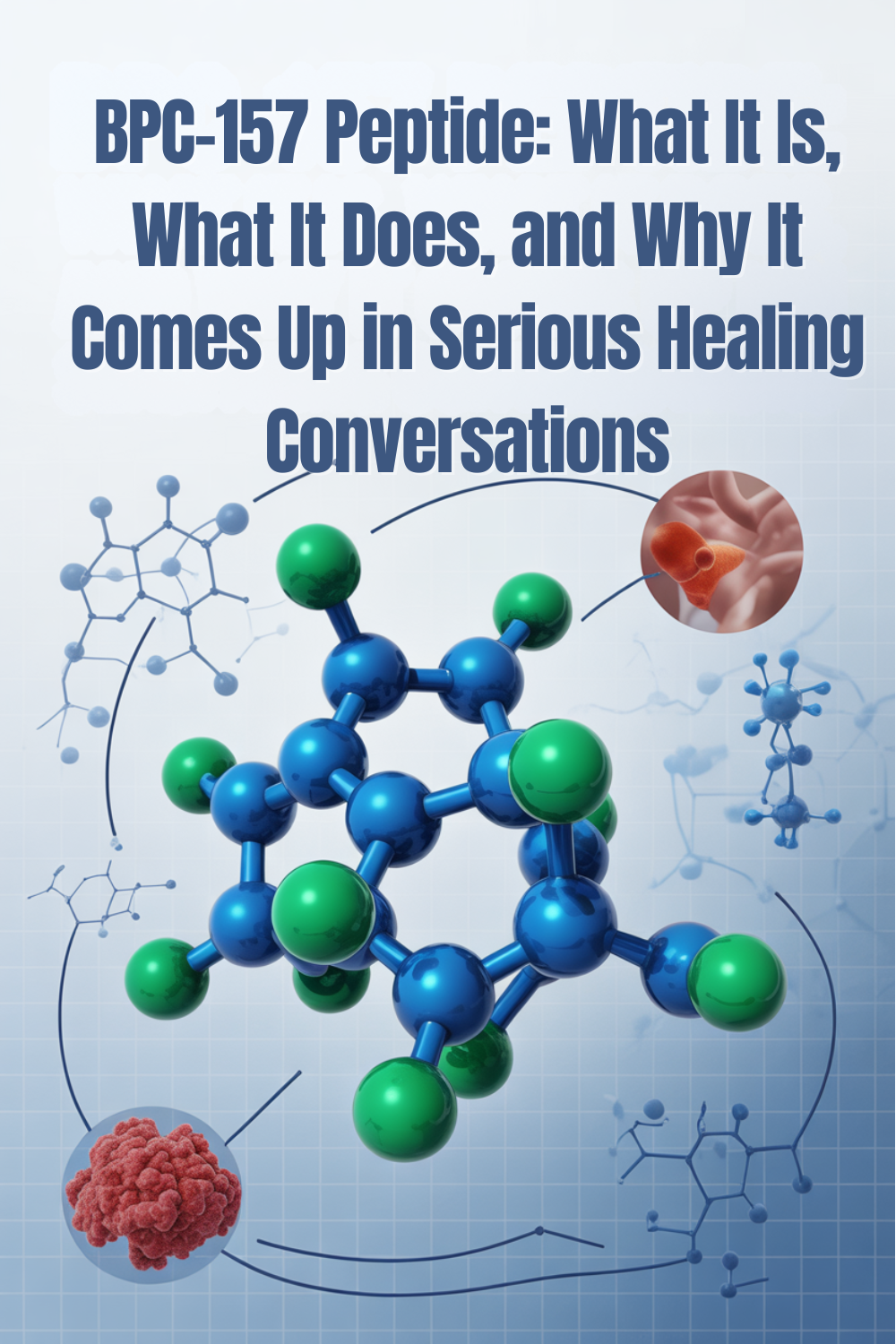
BPC-157 is a 15 amino acid peptide originally studied in gastric tissue for protective and repair properties. Most research remains preclinical, meaning animal and laboratory studies rather than large human trials, so it is best understood as promising but not yet fully established.
That distinction matters more than most people realize. Online, BPC-157 is often discussed as if it is a proven, widely accepted solution. In reality, it is a compound that emerged from research on protecting the gut lining and then expanded into broader areas like connective tissue repair, blood vessel signaling, and inflammation control.
When people say it helps multiple systems, what they are actually describing is overlap. These systems are not separate. They are coordinated. The same signaling pathways that influence gut integrity also influence tissue repair and inflammation.
Understanding that prevents a common mistake, which is expecting a targeted, symptom-specific effect. That is not what this is. It is being studied at a level where systems intersect, which is why it keeps appearing in more advanced healing conversations.
What are peptides and bioregulators?
Peptides are short chains of amino acids that act as signaling molecules in the body, helping regulate processes like immune response, tissue repair, and hormone communication. Bioregulators are peptides that support balance and coordination rather than forcing specific outcomes.
Most people expect peptides to behave like medications. Something that stimulates a process, suppresses a symptom, or creates a noticeable effect quickly. That expectation leads to misunderstanding.
Peptides operate differently. They interact with systems that already exist, rather than replacing them. Their role is closer to coordination than control.
This matters because their effectiveness depends on the state of the system they are entering. If the body is severely dysregulated, the response will not look the same as it would in a more stable system.
Explore more peptides here:
https://www.holisticlifewithjamie.com/tag/peptides-and-bioregulators/
What are the benefits of BPC-157?
BPC-157 is discussed for tissue repair, gut lining support, inflammation modulation, and blood vessel growth. These effects are based on preclinical research and observed use, not guaranteed outcomes, and reflect areas of scientific interest rather than confirmed clinical benefits.
The way most people approach this is by looking for a direct match between a symptom and a benefit. If they have joint pain, they want to know if it fixes joints. If they have gut issues, they want to know if it heals the gut.
That approach misses the bigger issue.
If the body is not completing the repair process, then the problem is not isolated to one area. It is systemic. That is why people often see patterns, not just symptoms.
So the more useful question becomes whether the body can carry out repair effectively at all. If that process is impaired, then improving the underlying coordination matters more than targeting a single outcome.
Is BPC-157 good for gut health?
BPC-157 is often associated with gut health because it was originally studied for gastric protection and may support gut lining integrity. Since the gut barrier plays a central role in immune signaling and nutrient absorption, this connection explains why it appears in deeper gut healing discussions.
If your gut feels unpredictable, that is rarely just about food. It reflects a broader signaling issue. The gut is one of the primary communication centers in the body, and when it becomes unstable, it affects immune responses, inflammation, and sensitivity throughout the system.
This is why gut issues often come with seemingly unrelated symptoms. It is not coincidence. It is communication breaking down across systems.
If you have questioned whether BPC-157 is being introduced too early in gut healing, this explains that timing more clearly:
https://www.holisticlifewithjamie.com/why-bpc-157-comes-up-in-gut-healing-conversations-and-when-its-premature/
What are the side effects of BPC-157?
BPC-157 side effects are not fully established due to limited human research. Reported experiences vary and may include fatigue, headaches, or digestive changes, though responses are inconsistent and long-term safety data is lacking.
This is where the conversation needs to stay grounded. There is a tendency to either dismiss concerns entirely or assume the worst. Neither is accurate.
The reality is that we do not have complete data. That means there is uncertainty, and uncertainty requires responsibility. Individual responses vary, and there is no way to predict outcomes with complete confidence.
That does not automatically mean avoid it. It means approach it with awareness, especially if you are already dealing with complex or chronic issues.
How does BPC-157 compare to TB-500?
BPC-157 is often associated with localized repair and gut support, while TB-500 is discussed for broader systemic repair signaling. They are frequently mentioned together but operate through different mechanisms and are not interchangeable.
Understanding the difference helps clarify why they are often paired. Healing is rarely isolated to one location. Even when symptoms appear localized, the signaling that controls repair is systemic.
BPC-157 is often discussed closer to the site of injury or dysfunction, while TB-500 is discussed in terms of overall coordination. That distinction is why they show up together in more advanced conversations.
For comparison:
https://www.holisticlifewithjamie.com/tb-500-peptide-benefits-uses-dosage-and-how-it-compares-to-bpc-157/
For deeper signaling context:
https://www.holisticlifewithjamie.com/growth-hormone-peptides-how-signaling-controls-tissue-repair/
Who is this conversation really for?
This conversation is for individuals who have already addressed basic health inputs but still feel stuck in the healing process. It applies to those recognizing that something deeper in the body’s repair signaling may not be functioning correctly.
This is not for someone looking for a quick fix. It is for someone who has already put in effort and is not seeing the expected results. That difference matters.
At this stage, the issue is not a lack of effort. It is a lack of resolution. The body is not completing what it starts, and that is what needs to be addressed.
If you are at the point where you have done the basics and your body still is not responding, you are not dealing with a simple input problem anymore.
You are dealing with a signaling problem.
If you are exploring BPC-157 as part of your next step, this is the source I trust:
https://go.biolongevitylabs.com/SH7A
If this is starting to click, you’re at the point where surface-level answers are no longer enough.
The missing piece is not more information. It’s understanding how your body is actually making decisions about repair, inflammation, and recovery.
Inside Health Foundations, we go deeper into how these systems work together so you can stop bouncing between random solutions and start making decisions that actually move things forward.