
What Are Bioregulators? How Peptide Bioregulators Work by System
Nothing about peptides makes sense until you realize bioregulators aren’t based on symptoms-they’re based on systems. This guide breaks down how they work, what they’re used for, and how to start thinking about them in a way that actually makes sense.
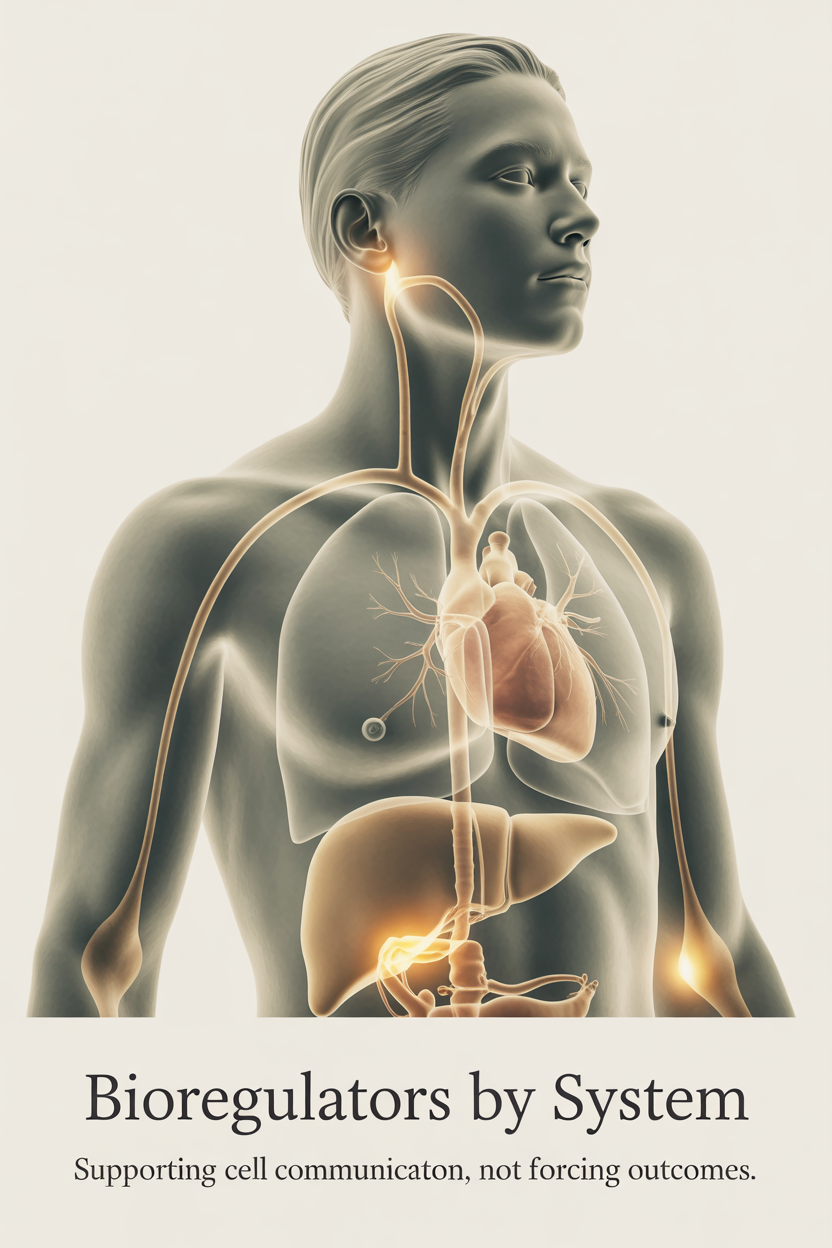
You’re trying to figure out which bioregulator to use… and nothing lines up.
You look at lists.
You see names.
You read benefits.
And it all sounds useful until you try to answer one question:
Which one actually applies to me?
Most people try to match bioregulators to symptoms.
That’s where everything breaks down.
Because bioregulators are not organized by symptoms.
They are organized by systems.
And once you see that, the confusion starts to disappear.
What People Are Asking
What are bioregulators?
Bioregulators are small peptide compounds that support cellular communication within specific tissues or organs. They help regulate how systems function over time rather than forcing immediate changes, making them different from medications or hormone-based approaches.
How do bioregulator peptides work?
Bioregulator peptides work by supporting communication between cells, helping tissues coordinate their function more effectively. Instead of overriding symptoms, they provide regulatory signals that allow the body to restore balance gradually.
What are bioregulators used for?
Bioregulators are used to support systems such as the brain, immune system, metabolism, and connective tissue. They are typically explored for long-term regulation and resilience rather than short-term symptom relief.
Table of Contents
In This Article
In this article, you’ll learn how to think about bioregulators in a way that actually makes sense.
We’ll break down:
- what bioregulators are
- how they work
- what they are used for
- how to understand them by system instead of symptoms


Nothing about peptides makes sense until you realize they’re not based on symptoms. They’re based on systems. Once you understand that shift, everything changes, from how you choose them to how your body responds. Here’s how bioregulators actually work. #bioregulators #peptides #guthealth #hormonehealth #cellularhealth #holistichealth #functionalmedicine #healthoptimization #wellnesstips #healingjourney
What are bioregulators?
Bioregulators are small peptide compounds that support cellular communication within specific tissues or organs. They are studied for how they help regulate function at a system level rather than forcing immediate changes, making them different from medications or hormones. I’ve organized all of my foundational content inside the Peptides and Bioregulators hub so you can see how everything connects.
Most people hear “peptides” and assume stimulation.
That’s not what this is.
Bioregulators are:
- tissue-specific
- system-focused
- communication-driven
They do not override symptoms.
They support how cells coordinate with each other.
If you’re newer to peptides, this builds on the foundation of how signaling works in the body, which I explain more fully in What Are Peptides? How the Body’s Signaling Molecules Control Repair, Metabolism, and Aging
How do bioregulator peptides work in the body?
Bioregulator peptides work by supporting communication between cells, helping tissues coordinate their function more effectively. They act as signaling molecules that guide cellular activity rather than forcing a response, allowing the body to restore balance over time.
Most people try to use them like tools for symptoms.
That’s the wrong framework.
A better way to think about them:
- they act like instructions, not stimulants
- they guide function rather than forcing it
- they support regulation instead of overriding it
Because of this, their effects are:
- gradual
- stabilizing
- system-based
Not immediate or aggressive.
What are bioregulators used for?
Bioregulators are used to support specific systems in the body by improving cellular communication and coordination. They are commonly explored for brain function, immune balance, metabolic health, and tissue repair, helping regulate how systems function over time rather than targeting symptoms directly.
Most people want a quick answer.
“What is this used for?”
But that question misses the point.
Bioregulators are typically used when:
- a system is under long-term stress
- communication has broken down
- symptoms are showing up across multiple areas
The goal is not to fix a symptom.
The goal is to support how the system functions as a whole.
This is why they’re often approached differently than more targeted peptides, like those discussed in Healing Peptides for Gut Repair: How TB-500 and BPC-157 Support Tissue Recovery.
What systems do bioregulators support?
Bioregulators support specific systems in the body by targeting tissue-level communication within organs such as the brain, immune system, liver, and cardiovascular system. Each bioregulator is associated with a particular system, helping regulate function and coordination rather than addressing symptoms directly.
This is where everything starts to click.
They are not random.
They are organized.
This same system-based framework also applies to gut healing, where signaling pathways influence digestion, inflammation, barrier integrity, and tissue recovery over time. That broader concept becomes easier to understand when looking at how peptides support healing through signaling within the digestive tract.
Brain & Nervous System
- Pinealon supports circadian rhythm and pineal signaling
- Cerebrolysin peptides support neuronal metabolism
- Cortexin supports cognitive signaling and stress adaptation
- Epitalon supports gene expression and aging pathways
If brain function is your focus, this connects to how signaling influences cognition, which I break down further in Best Peptides for Brain Function: How Peptides Support Brain Health and Cognitive Performance.
Cardiovascular System
- Vasculin supports endothelial communication
- Cardiogen supports heart tissue coordination
Respiratory System
- Bronchogen supports lung tissue signaling and repair
Immune System
- Thymalin supports T-cell maturation
- Thymogen supports adaptive immune signaling
- Vilon supports immune regulation
Liver & Metabolic System
- Hepatogen supports liver repair signaling
- Pancreagen supports metabolic coordination
This ties directly into how metabolic signaling works more broadly, which I explain in Peptides for Metabolic Health: How to Choose, Dose, and Use Them Correctly.
Mitochondrial signaling also plays a major role in how energy systems adapt over time, which is why topics like mitochondrial uncoupling and metabolic flexibility are becoming increasingly important in regenerative health discussions.
Musculoskeletal System
- Cartalax supports cartilage metabolism
- Chondramine supports connective tissue signaling
- Myogen supports muscle repair
Reproductive & Endocrine System
- Ovariamin supports ovarian signaling
- Testagen supports testicular regulation
- Gonadotropin-regulating peptides support hormonal communication
Pineal & Aging
- Epitalon and Pinealon support circadian rhythm and telomere regulation
Why Does Thinking by System Change Everything?
Thinking by system changes everything because the body functions through interconnected signaling networks rather than isolated symptoms. Fatigue, inflammation, digestion, hormones, and recovery are often connected through larger communication pathways. Looking at systems instead of symptoms helps create more targeted decisions and a clearer understanding of what may actually be driving dysfunction.
Most people approach health by chasing symptoms one at a time.
Fatigue becomes an energy problem.
Bloating becomes a gut problem.
Brain fog becomes a cognitive problem.
But the body does not operate in isolated compartments.
Systems constantly communicate with each other through signaling pathways involving hormones, inflammation, metabolism, nervous system regulation, immune coordination, and tissue repair.
This is why system-based thinking often creates more clarity than symptom-based thinking alone.
Instead of asking:
“What suppresses this symptom?”
The better question becomes:
“What system is struggling to communicate properly?”
How do you choose the right bioregulator?
Choosing the right bioregulator involves identifying which system in the body needs support rather than focusing on symptoms. This requires looking at long-term patterns, system stress, and where communication has broken down to make a more targeted decision.
This is where most people get stuck.
They’re asking:
“What fixes this symptom?”
Instead, the question becomes:
“Which system needs support?”
That shift changes everything.
If you’re realizing your symptoms may be connected through larger system patterns instead of isolated problems, The Body Signal Starter helps you begin interpreting what your body may actually be trying to communicate.
Instead of chasing random symptoms, you’ll learn how to identify common signaling patterns involving energy, digestion, inflammation, stress, hormones, and recovery.
As you start thinking this way, the next question becomes where to even find options that are organized by system instead of outcomes.
Most sources are still built around performance or results.
What’s more useful is exploring sources that organize bioregulators by system, so you can actually see how they’re structured and intended to be used.
If you’re ready to start exploring what that looks like in a practical way, you can explore available bioregulators by system and see how they’re actually organized and used in a more real-world context.
If this is starting to click…
You’re probably realizing that symptoms are rarely as isolated as they first appear.
Brain fog may not just be a brain issue.
Digestive symptoms may not just be a gut issue.
Low energy may not just be exhaustion.
Systems influence each other constantly through signaling, communication, inflammation, hormones, metabolism, circulation, and repair pathways.
That is why looking at the body through a system-based lens often creates far more clarity than chasing symptoms one at a time.
Understanding that shift is what separates random guessing from strategic decision-making.
If you want to go deeper into how to identify system breakdown patterns, prioritize what matters first, and understand how signaling disruptions connect across the body, that’s exactly what I teach inside the Holistic Life Membership.
What’s Actually Happening Beneath the Surface
Bioregulators are not just about peptides.
They are about signaling.