
Why Gut Healing Fails When You Treat Symptoms Instead of Systems
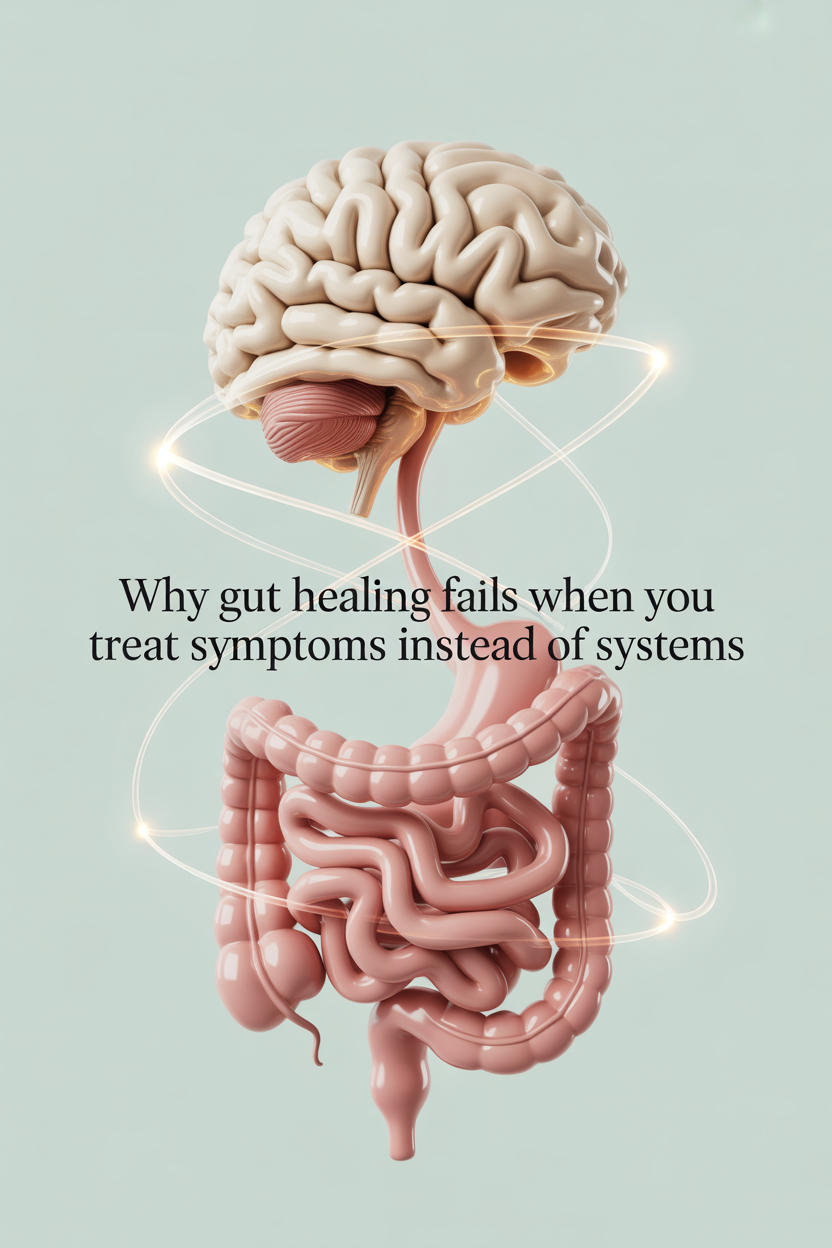
Gut healing fails when symptoms like bloating, constipation, diarrhea, food sensitivities, and gut inflammation are treated in isolation instead of addressing the gut–brain connection, nervous system regulation, stress, digestion, and whole-body systems that control gut health.
Most gut approaches fail quietly.
Not because the person didn’t try hard enough.
Not because they chose the wrong diet or supplement.
But because the gut was treated as the problem instead of the messenger.
Bloating, reflux, constipation, diarrhea, food reactions, and “inflammation” are not standalone issues. They are outputs. When you chase outputs without understanding the system producing them, the gut never stabilizes. It adapts, compensates, and eventually flares again.
This article is about orientation.
Not fixes.
Not protocols.
Not what to take.
It is about understanding why gut healing stalls when symptoms are treated in isolation rather than as part of a larger, regulated system.
Symptoms Are Not the Problem
Gut symptoms are signals, not failures.
They are the body’s way of communicating that coordination has been lost somewhere upstream. When digestion slows, pressure builds, or tolerance narrows, the gut is responding to conditions it cannot safely manage.
This is why symptom suppression often works briefly. The body complies, then compensates. Over time, the original imbalance resurfaces in a new form.
Many people assume persistent symptoms mean the gut is damaged. More often, the gut is doing exactly what it was designed to do under strain.
Understanding this distinction changes everything. When symptoms are treated as the enemy, the system stays reactive. When they are treated as feedback, the system has a chance to reorganize.
For more context on how inflammation is often misunderstood, see Is Your Gut Actually Inflamed? 7 Sneaky Clues.
The Gut Is a System, Not a Container
The gut is not a hollow tube waiting to be filled with the right foods or supplements. It is an adaptive interface between the external world and the internal environment.
Digestion depends on timing, signaling, circulation, nervous system input, immune tolerance, and waste removal. If one of these lags, the entire system compensates.
This is why two people can eat the same food and respond completely differently. The issue is rarely the food alone. It is the system receiving it.
When gut healing is framed as “fixing digestion,” larger contributors are missed. Stress signaling, motility, lymphatic flow, and microbial byproducts all influence how the gut behaves.
This systems view is foundational. Without it, gut healing becomes a series of disconnected attempts rather than a coordinated process.
Why Inflammation Is Often Misdiagnosed
Inflammation is frequently blamed when the real issue is congestion or mis-timing.
A sluggish gut can look inflamed on paper. Gas, pressure, irregular stools, and food sensitivity often reflect poor clearance rather than active immune attack.
When drainage pathways are overwhelmed, the body limits throughput. Slowing digestion is protective, not pathological.
This is why addressing inflammation without addressing movement and clearance often backfires. The system tightens instead of resolving.
For a deeper look at this pattern, read 3 Drainage Mistakes That Stall Your Gut Healing.
Stress, Drainage, and the Missing Context
Stress does not just affect mood. It directly alters digestion, enzyme output, bile flow, and motility.
When the nervous system is locked in vigilance, the gut shifts into a holding pattern. Digestion slows. Clearance stalls. Fermentation increases.
Many gut plans ignore this context entirely. They focus on microbial balance while the nervous system remains dysregulated.
This disconnect explains why people feel worse when they are “doing everything right.” The system is overloaded, not resistant.
A deeper exploration of this relationship is covered in Stress and Cortisol: Your Gut’s Worst Frenemy.
When Interventions Help and When They Backfire
Interventions are not inherently harmful. Many are necessary. The issue is timing and context.
Antibiotics, antimicrobials, elimination diets, and aggressive gut strategies can be lifesaving in the right window. Used without systems awareness, they can destabilize an already stressed network.
This is why one person improves while another deteriorates under the same approach. The system was not ready for the intervention.
A balanced perspective on this topic is explored in Antibiotics: When They Save You… and When They Wreck You.
The article continues below for Health Foundations members, with deeper education on how this system works and how to think through next steps responsibly.
FAQ: Gut Healing & Systems Thinking
Why does gut healing fail even when I follow the right diet?
Because digestion depends on nervous system signaling, circulation, and clearance. When those systems are strained, diet alone cannot stabilize gut function.
Can gut symptoms exist even if test results look normal?
Yes. Many gut symptoms reflect regulation and timing issues rather than structural damage or active disease, which standard tests often miss.
Is gut inflammation always the root problem?
Not always. What looks like inflammation is often congestion, slowed motility, or protective downshifting by the body.
Why do gut symptoms get worse during stress?
Stress directly alters digestion, bile flow, motility, and blood distribution. The gut responds to nervous system signals before it responds to food.
Why do some gut treatments help briefly, then stop working?
Short-term relief often comes from suppressing symptoms. Without improving system coordination, the body compensates and symptoms return.
Does this mean supplements and treatments don’t work?
No. It means timing and context matter. Interventions are most effective when the body is prepared to receive them.
What does it mean to treat the gut as part of a system?
It means understanding how digestion interacts with the nervous system, immune response, circulation, and metabolism instead of treating symptoms in isolation.