
Semaglutide (Ozempic), Tirzepatide (Mounjaro), and Tesofensine: Peptides Studied for Metabolism
Semaglutide, tirzepatide, and tesofensine do not force fat loss. They shift how your body signals hunger, insulin, and energy use. When your system responds, results follow. This explains what these compounds actually do and why signaling drives outcomes
If fat loss were just about eating less, these drugs would not exist.
But they do.
And they have completely changed how people think about metabolism.
Semaglutide.
Tirzepatide.
Tesofensine.
They are being framed as weight loss solutions.
But that framing misses what is actually happening.
They do not burn fat.
They change signals.
And when your body is able to respond to those signals, the outcome can change in a way that feels almost effortless.
FAQ
What does GLP-1 stand for?
GLP-1 stands for glucagon-like peptide-1, a hormone that helps regulate appetite, insulin release, and blood sugar levels. It plays a key role in signaling fullness and maintaining metabolic balance.
Are Ozempic and tirzepatide the same?
No. Ozempic (semaglutide) targets GLP-1 receptors, while tirzepatide targets both GLP-1 and GIP pathways. Tirzepatide affects a broader range of metabolic signals.
What is tesofensine, and is it a peptide?
Tesofensine is not a peptide. It is a centrally acting compound that increases dopamine, serotonin, and norepinephrine, reducing appetite and influencing energy expenditure through the brain.
Do GLP-1 medications burn fat directly?
GLP-1 medications do not directly burn fat. They influence hunger, insulin response, and energy balance through signaling. Fat loss happens as a downstream effect when these systems shift and the body moves into a more stable metabolic state.
Table of Contents
- What Do Semaglutide and Tirzepatide Actually Do in the Body?
- Why Don’t GLP-1 Medications Burn Fat Directly?
- What Is the Difference Between Semaglutide, Tirzepatide, and Tesofensine?
- Are Ozempic and Tirzepatide the Same Thing?
- What Determines How Well These Compounds Work in the Body?
- What Is the Missing Piece Most People Overlook with GLP-1 Therapies?
In This Article
- What these compounds are actually doing in the body
- Why fat loss is a downstream effect, not a direct action
- How each compound works differently
- Why results are inconsistent
- What determines whether they work at all





You’re eating less. Trying harder. And your body still isn’t responding.
What Do Semaglutide and Tirzepatide Actually Do in the Body?
Semaglutide and tirzepatide influence appetite, insulin response, and blood sugar regulation by mimicking incretin hormones. These changes increase satiety, slow digestion, and improve metabolic signaling, allowing the body to naturally reduce intake and stabilize energy use.
Now zoom out.
This is not about forcing restriction.
This is about changing how the body decides when to eat.
- Hunger signals quiet down
- Blood sugar stabilizes
- Energy swings become less extreme
This is happening at the level of appetite and satiety signaling, where the body is constantly adjusting how much energy it takes in and how it uses it.
That is a signaling shift.
Not a calorie strategy.
If you haven’t looked at how energy production shapes these responses, that connection becomes much clearer.
Why Don’t GLP-1 Medications Burn Fat Directly?
GLP-1 medications do not directly burn fat. They modify signaling related to hunger, insulin, and energy balance. Fat loss occurs as a downstream effect when these systems shift and the body moves into a more metabolically favorable state.
This is where expectations break.
People expect:
- take something
- fat disappears
But the body does not work like that.
Fat loss is a decision made through signaling.
That decision is driven by how your body determines whether energy is stored or used in the first place.
These compounds:
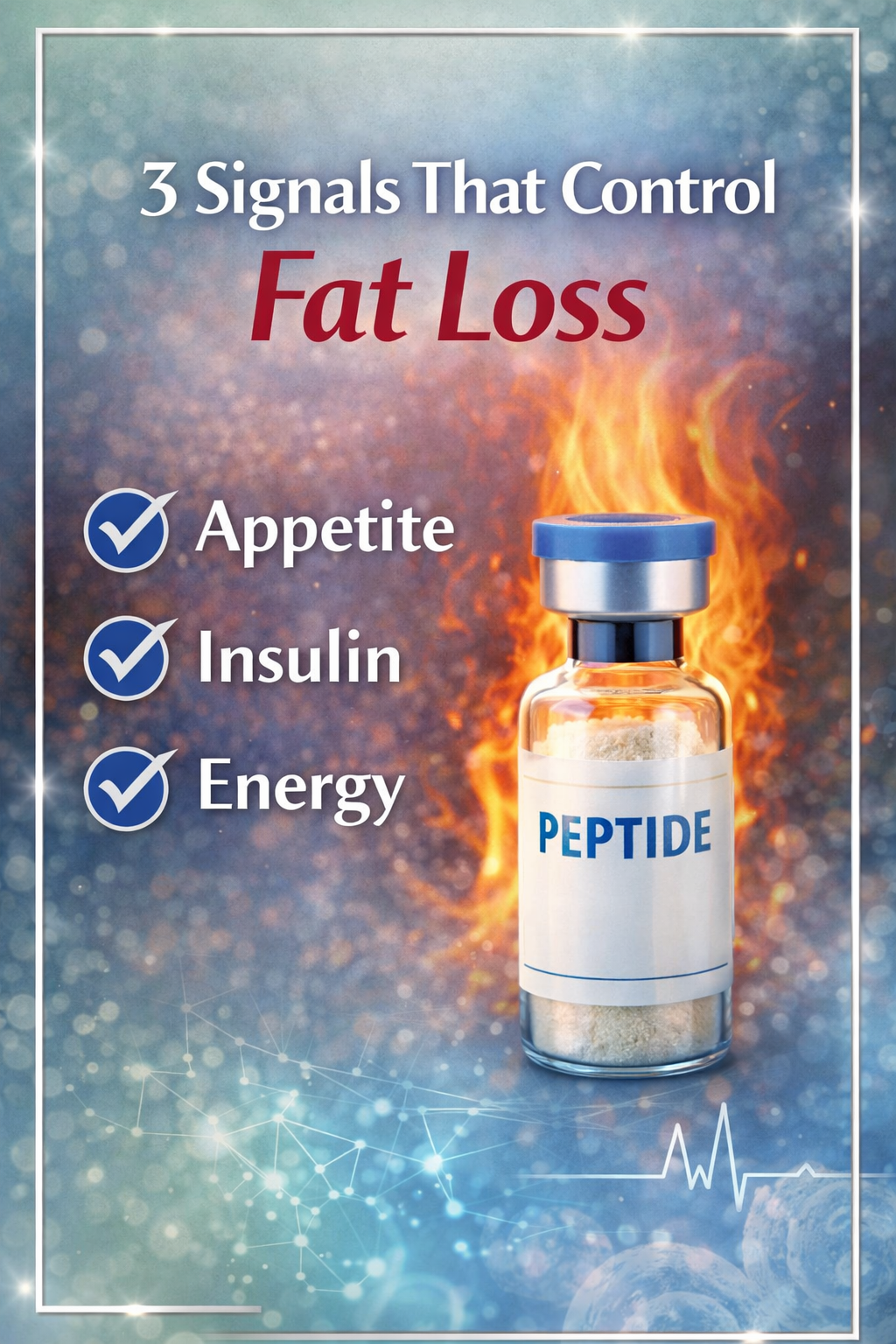
- reduce appetite
- improve insulin response
- stabilize energy
And that creates conditions where fat loss becomes possible.
If you have already read about how peptides influence signaling rather than forcing outcomes, this is that principle playing out in real time.
This is the same signaling principle seen across peptides more broadly, where the goal is not to force change, but to shift how the body communicates.
What Is the Difference Between Semaglutide, Tirzepatide, and Tesofensine?
Semaglutide targets GLP-1 receptors, tirzepatide targets both GLP-1 and GIP pathways, and tesofensine works on brain neurotransmitters that regulate appetite and energy. While all influence weight loss, they act through different signaling systems.
Break it down simply:
- Semaglutide
targets GLP-1
→ appetite control
→ glucose regulation - Tirzepatide
targets GLP-1 + GIP
→ broader metabolic signaling - Tesofensine
acts on dopamine, serotonin, norepinephrine
→ brain-driven appetite suppression
Two work through hormonal signaling in the gut.
One works through neurotransmitters in the brain.
Same direction.
Different control systems.
Are Ozempic and Tirzepatide the Same Thing?
Ozempic (semaglutide) and tirzepatide are not the same. Semaglutide targets GLP-1 receptors only, while tirzepatide targets both GLP-1 and GIP, influencing a broader range of metabolic pathways and signaling mechanisms.
This difference matters.
Because expanding the number of pathways influenced:
- can increase effectiveness
- but also changes how the body adapts
Which is why comparing them directly without context often leads to confusion.
What Determines How Well These Compounds Work in the Body?
These compounds work by improving signaling, but how strongly they influence outcomes depends on how well the body is already functioning. When metabolic systems are responsive, these signals translate more effectively into appetite control, energy stability, and improved regulation.
This is where real-world results diverge.
You will hear:
- “It worked, then stopped”
- “I plateaued”
- “It didn’t do anything”
That usually points to deeper interference:
- insulin resistance
- chronic inflammation
- poor cellular energy production
When those are present, the signal is sent.
But the response is not as strong as it could be.
This is also why people dealing with metabolic dysfunction often experience stalled progress even when using advanced tools.
What Is the Missing Piece Most People Overlook with GLP-1 Therapies?
The effectiveness of GLP-1 therapies depends on the underlying metabolic environment. When metabolic function is supported, these compounds tend to work more smoothly, because the body is able to respond more efficiently to the signals being introduced.
This is the part most people skip.
Because it is easier to ask:
“What should I take?”
Instead of asking:
“Is my body able to respond?”
That question leads directly into metabolic function, energy production, and signaling integrity.
Which is where the bigger picture starts to come into focus.
These aren’t forcing your body to change.
They’re giving your body a signal it can finally respond to.
Understand the Signal. Support the Response.
Understanding how these compounds influence signaling is the first step.
Below, we walk through what actually determines whether your body responds to those signals, where that response starts to weaken, and how to think through this in a way that leads to better outcomes.