Peptides for Metabolic Health: How to Choose, Dose, and Use Them Correctly
Peptides for metabolic health don’t directly burn fat-they influence appetite, insulin, and energy signaling. Learn why semaglutide, tirzepatide, and newer peptides work for some people and fail for others, and how your metabolic signals determine results.

You’re doing everything right… so why isn’t it working?
You’re eating less.
You’re trying to stay consistent.
You’ve even considered peptides or started them.
And still:
- the scale barely moves
- your energy is inconsistent
- your body does not respond the way you expected
At some point the question changes.
Not:
“What else should I try?”
But:
“What is my body actually responding to?”
Because fat loss is not driven by effort.
It is controlled by signals.
Frequently Asked Questions
Why am I not losing weight even though I’m eating less and exercising?
If you’re not losing weight despite eating less and exercising, your body may be conserving energy due to stress, hormonal signaling, or metabolic adaptation. Fat loss depends on internal signals like insulin, energy availability, and recovery, not just effort or calorie reduction.
Do peptides actually help with weight loss?
Peptides can support weight loss by influencing appetite, insulin response, and energy signaling. They do not directly burn fat. Their effectiveness depends on how your body responds to those signals and whether your metabolism allows fat to be released.
Why do GLP-1 medications stop working after a while?
GLP-1 medications can lose effectiveness as the body adapts to reduced intake and stabilizes new signaling patterns. If deeper metabolic signals are not addressed, fat loss may plateau even while continuing the medication.
Can you lose muscle while using peptides like semaglutide?
Yes. If protein intake and resistance training are not maintained, weight loss can include muscle loss. This lowers metabolic capacity and increases the risk of plateaus or weight regain.
What peptides are used for metabolism and fat loss?
Peptides used for metabolic health include semaglutide, tirzepatide, and emerging multi-pathway compounds like retatrutide. Each influences different signaling pathways related to appetite, insulin, and energy use.
Table of Contents
- What controls fat loss in the body?
- How do peptides influence metabolism and fat storage?
- How do GLP-1 peptides like semaglutide affect weight loss?
- What makes tirzepatide different from semaglutide?
- What is retatrutide and why is it getting attention?
- Why don’t peptides work for everyone?
In This Article
- why fat loss is controlled by signaling, not just calories
- how peptides influence appetite, insulin, and energy use
- differences between semaglutide, tirzepatide, and newer peptides
- why results vary from person to person
- where peptides actually fit in metabolic health




What controls fat loss in the body?
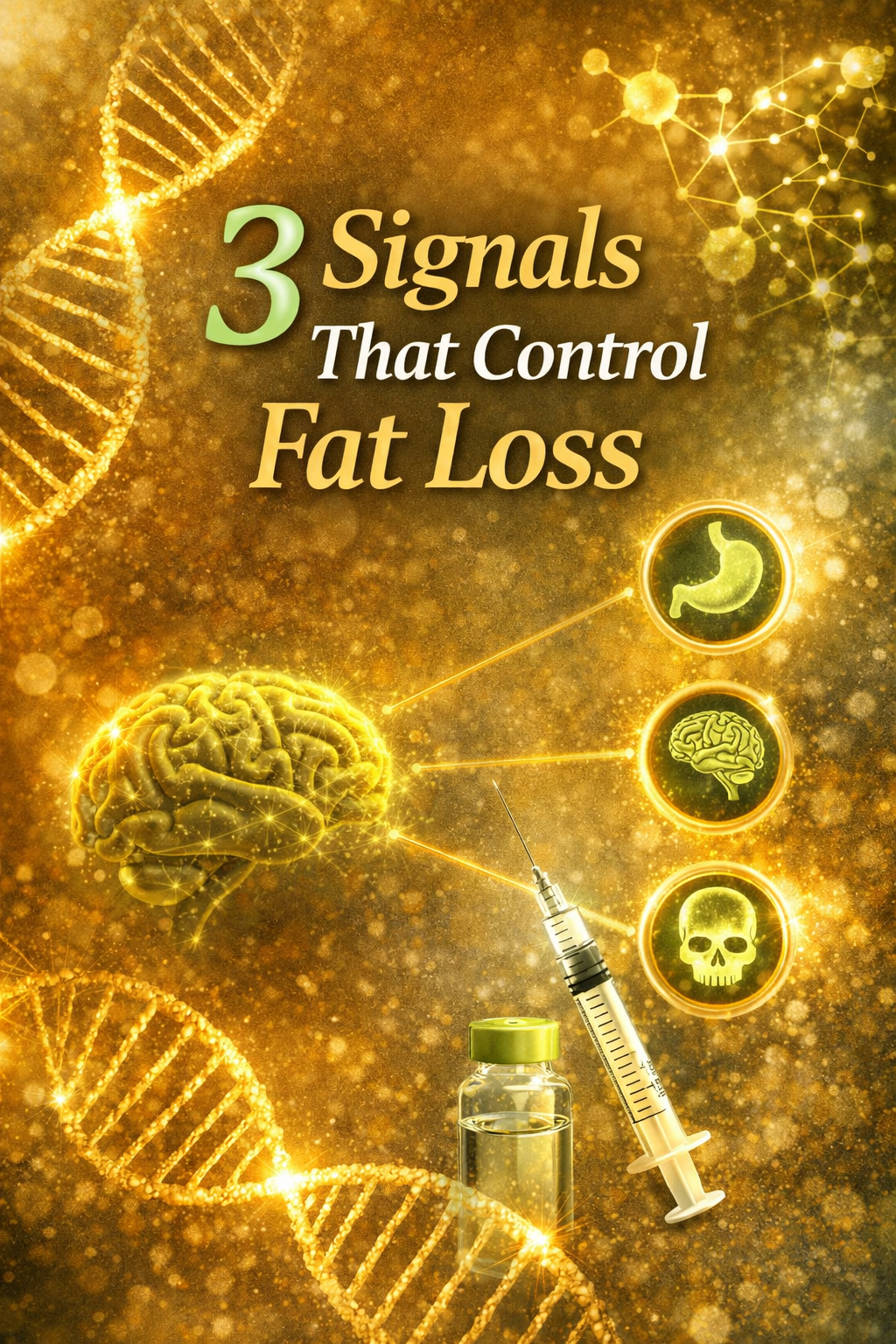
Fat loss is controlled by metabolic signaling, including hormones like insulin, stress signals, and energy availability. These signals determine whether your body stores fat or uses it. If your body perceives stress or low energy, it prioritizes conservation, making fat loss difficult regardless of effort.
Your metabolism does not operate in isolation. It is tied directly to how your body produces and uses energy ➡️ Mitochondria & Energy Production
If your body senses:
- inconsistent energy
- poor recovery
- high stress
…it shifts toward protection.
That means:
- storing fat
- reducing output
- slowing progress
If energy production is impaired at the cellular level, your body will resist fat loss no matter how hard you push ➡️ Mitochondrial Dysfunction Masquerading as Brain Fog, Hormone Imbalance, and Chronic Fatigue
Fat loss is not triggered by effort.
It is allowed by signaling.
How do peptides influence metabolism and fat storage?
Peptides influence metabolism by acting as signaling molecules that affect appetite, insulin response, and energy use. They do not directly burn fat. Instead, they change how your body interprets energy availability, which can support or limit fat loss depending on your metabolic state.
Peptides are messengers.
They shift:
- hunger signals
- blood sugar response
- energy distribution
The same meal can produce different outcomes depending on how your body is signaling internally.
This is why some people burn fat efficiently while others stay stuck even when doing the same things ➡️ What Is Metabolic Flexibility? What Causes Inflexibility and How Fasting Helps Restore It
Peptides do not override your system.
They amplify it.
How do GLP-1 peptides like semaglutide affect weight loss?
GLP-1 peptides like semaglutide reduce appetite, slow gastric emptying, and improve blood sugar control. These effects can lead to lower calorie intake and more stable energy levels, but they do not directly increase fat burning or correct underlying metabolic dysfunction.
Semaglutide works by reducing intake.
You eat less.
Insulin lowers.
Fat may be released.
But there is a tradeoff.
If intake drops too low:
- protein drops
- muscle loss increases
- metabolism slows
Weight loss can happen without improving the system that created the problem.
Why Dose Alone Doesn’t Explain Your Results
Dose alone does not explain peptide results because your body’s response depends on both the strength of the signal and your current metabolic state. The same dose can produce completely different outcomes depending on digestion, inflammation, and energy stability.
You’ll hear this advice everywhere:
Start low. Go slow.
That’s true.
But it’s incomplete.
Dose is only half the equation.
Your response to a peptide is not just about how much you take.
It’s about what your body does with that signal.
The Real Equation
Your outcome is:
dose × system condition
Same dose.
Different body.
Different result.
What Most People Miss
Peptides don’t create entirely new reactions.
They amplify what’s already happening.
If your system is stable:
- appetite regulates
- energy stabilizes
- fat loss becomes more predictable
If your system is unstable:
- digestion slows too much
- bloating increases
- nausea appears
- fatigue worsens
Why This Matters for Dosing
A higher dose does not just mean a stronger effect.
It creates a stronger signal.
If your system is not ready for that signal:
- side effects increase
- tolerance drops
- results become inconsistent
Where People Go Wrong
They feel worse and assume:
- they need a different peptide
- they need to push through
- they need a higher dose
That usually makes it worse.
A Better Way to Read Your Body
If symptoms increase, ask:
- What is this signal amplifying?
- Is my digestion already compromised?
- Is inflammation already present?
Practical Example
If you already have:
- bloating
- food sensitivities
- slow digestion
GLP-1–based peptides can intensify those issues by:
- slowing gastric emptying further
- increasing food contact time
- amplifying irritation
The Shift That Changes Everything
The goal is not to force the peptide to work.
The goal is to understand:
whether your body can tolerate the signal you’re introducing
Bottom Line
Dose matters.
System tolerance matters more.
Peptides don’t create problems.
They reveal and amplify what’s already there.
What makes tirzepatide different from semaglutide?
Tirzepatide targets both GLP-1 and GIP receptors, influencing appetite and insulin signaling more broadly than semaglutide. This dual action improves how the body processes and uses energy, making it more effective for metabolic dysfunction and insulin resistance.
Tirzepatide does more than suppress appetite.
It improves:
- insulin sensitivity
- nutrient handling
- energy use
This increases the likelihood that your body will use fuel instead of storing it.
This is a signaling upgrade, not just a calorie reduction tool.
What is retatrutide and why is it getting attention?
Retatrutide is a multi-pathway peptide that targets GLP-1, GIP, and glucagon receptors. It influences appetite, insulin response, and energy expenditure, making it one of the first peptides to affect both energy intake and output.
Most peptides reduce intake.
Retatrutide may also increase output.
This changes how your body uses energy, not just how much you consume.
This is where the conversation shifts toward efficiency of energy use and metabolic output ➡️ Mitochondrial Uncoupling: What It Is and Why It’s Trending
Why don’t peptides work for everyone?
Peptides don’t work the same for everyone because their effects depend on the body’s current metabolic state. Factors like stress, sleep, inflammation, and energy production influence how the body responds to signaling changes.
Same peptide.
Different result.
Because no one starts from the same place.
If your system is:
- stressed
- inflamed
- under-recovered
…the response will be limited.
This variability in signaling is also why peptides are being explored for brain function and cognitive performance ➡️ Best Peptides for Brain Function: How Peptides Support Brain Health and Cognitive Performance
Peptides work within your system.
They do not replace it.
If You’re Tired of Guessing
If you’re starting to realize this isn’t about finding the next tool…
it’s about understanding what your body is responding to…
Inside Health Foundations, you learn how to:
- identify your metabolic patterns
- understand your signals
- make decisions without guessing
And inside the Restoration Framework, you apply it.
The article continues below for Restoration Framework members, where we move from understanding to execution.
Restoration Framework: Peptide Protocols for Metabolic Health
This is where most people get it wrong. They use peptides without a strategy. Here’s how to actually apply them.
How to Know Which Signal You’re Dealing With
If your issue is:
- constant hunger or cravings → appetite dysregulation
- fatigue with stubborn fat → energy conservation
- weight fluctuations and crashes → insulin instability
You are not dealing with the same problem, even if the outcome looks similar.
Step 1: Define the Signal
Choose one primary target:
- appetite dysregulation
- insulin resistance
- energy stagnation
Do not stack randomly.
Step 2: Match the Peptide to the Signal
Appetite driven:
- semaglutide
Insulin and metabolic dysfunction:
- tirzepatide
Plateau or resistant metabolism:
- multi-pathway peptides such as retatrutide
Step 3: Dosing Framework
Start low.
Increase slowly.
Hold until stable response.
Typical clinical ranges:
- semaglutide: 0.25 mg to 2.4 mg weekly
- tirzepatide: 2.5 mg to 15 mg weekly
Dose based on response, not impatience.
Step 4: Protect Metabolic Capacity
Non-negotiable:
- protein: 0.8 to 1 g per lb ideal body weight
- resistance training: 2 to 4 times per week
- daily electrolytes
- monitor digestion
If muscle is lost, metabolism is reduced.
Step 5: Decision Tree
If appetite decreases but energy drops:
- increase protein
- increase resistance training
Do not increase dose.
If weight loss stalls:
- assess intake
- assess muscle retention
- then adjust dose if needed
If side effects increase:
- hold or reduce dose
If weight drops rapidly:
- assess for muscle loss immediately
Step 6: Exit Strategy
If nothing changes underneath:
- appetite returns
- weight returns
Plan for:
- tapering
- maintaining muscle
- maintaining metabolic function
In Case You Skimmed
- Fat loss is controlled by signaling, not effort
- Peptides influence appetite, insulin, and energy use
- Semaglutide controls intake
- Tirzepatide improves metabolic signaling
- Retatrutide targets multiple pathways
- Muscle loss is the biggest risk
- Strategy determines outcome, not the peptide
Jamie Shahan, MSN, CRNA, RN
Empowering Holistic Health
Curator of forgotten wisdom with a modern understanding of why it works.
🌐 Connect with me on Social Media:
Disclaimer
The information provided on this website, in associated blogs, courses, and materials, is for general educational and informational purposes only. It is not medical advice and should not be interpreted as such.
I am not a medical doctor. The content I share reflects my personal opinions, experiences, and research. It is not intended to diagnose, treat, cure, or prevent any disease, condition, or illness.
You should not rely on the information here as a substitute for professional medical care, advice, or treatment. Always consult with a licensed healthcare provider before making any decisions regarding your health, especially if you are pregnant, nursing, taking prescription medications, or managing a medical condition.
By reading this website or using any related materials, you acknowledge and agree that:
- You are fully responsible for your own health decisions.
- The author and publisher of this content assume no liability for any harm, loss, or adverse effects arising directly or indirectly from the use, misuse, or interpretation of the information provided.
- No guarantees are made regarding the outcomes of applying any ideas, suggestions, or protocols discussed. Results will vary for each individual.
Affiliate Disclosure
Some products or tools mentioned may include affiliate links. This means that if you choose to purchase through those links, I may earn a small commission at no extra cost to you. I only recommend products I have personally used, researched, or would recommend to someone I love.
Use at Your Own Risk
By accessing this website and its materials, you agree that you are doing so voluntarily and that you assume full responsibility for any decisions you make regarding your health, lifestyle, or purchases.