BPC-157 Peptide: What It Is, What It Does, and Why It Comes Up in Serious Healing Conversations
BPC-157 is a peptide increasingly discussed in holistic and integrative health spaces for its potential role in tissue repair, gut integrity, and inflammation signaling. Learn what the BPC-157 peptide does, what the research suggests, and how peptides may support healing alongside lifestyle changes.
If you are truly serious about your journey of healing yourself, not just symptom chasing, you have probably crossed paths with the growing conversation around peptides and bioregulators. These compounds tend to surface quietly in more advanced wellness and integrative health spaces, often after people realize that diet, supplements, and lifestyle changes alone are not always enough to restore deeper regulation.
One peptide that comes up repeatedly is BPC-157. Originally studied for its role in tissue protection and repair, the BPC-157 peptide has gained attention for its potential effects on the gut, connective tissue, inflammation signaling, and overall recovery. Before deciding anything else, it matters to understand what this peptide is, what it does in the body, and what the research actually shows.
What Are Peptides and Bioregulators?
Peptides are short chains of amino acids. Amino acids are the basic building blocks of the body, and when they link together in specific sequences, they function as messengers. The human body already produces and uses thousands of peptides every day to regulate digestion, immune signaling, hormone communication, tissue repair, and cellular coordination.
Bioregulators are a subset of peptides that support regulation rather than force outcomes. Instead of overriding symptoms or stimulating systems aggressively, bioregulators are understood as signals that help the body restore balance and communication at the cellular level. This is why peptide therapy is often discussed differently than medications. Peptides are not hormones, stimulants, or pain blockers. They interact with systems the body already uses to maintain order.
What Is the BPC-157 Peptide?
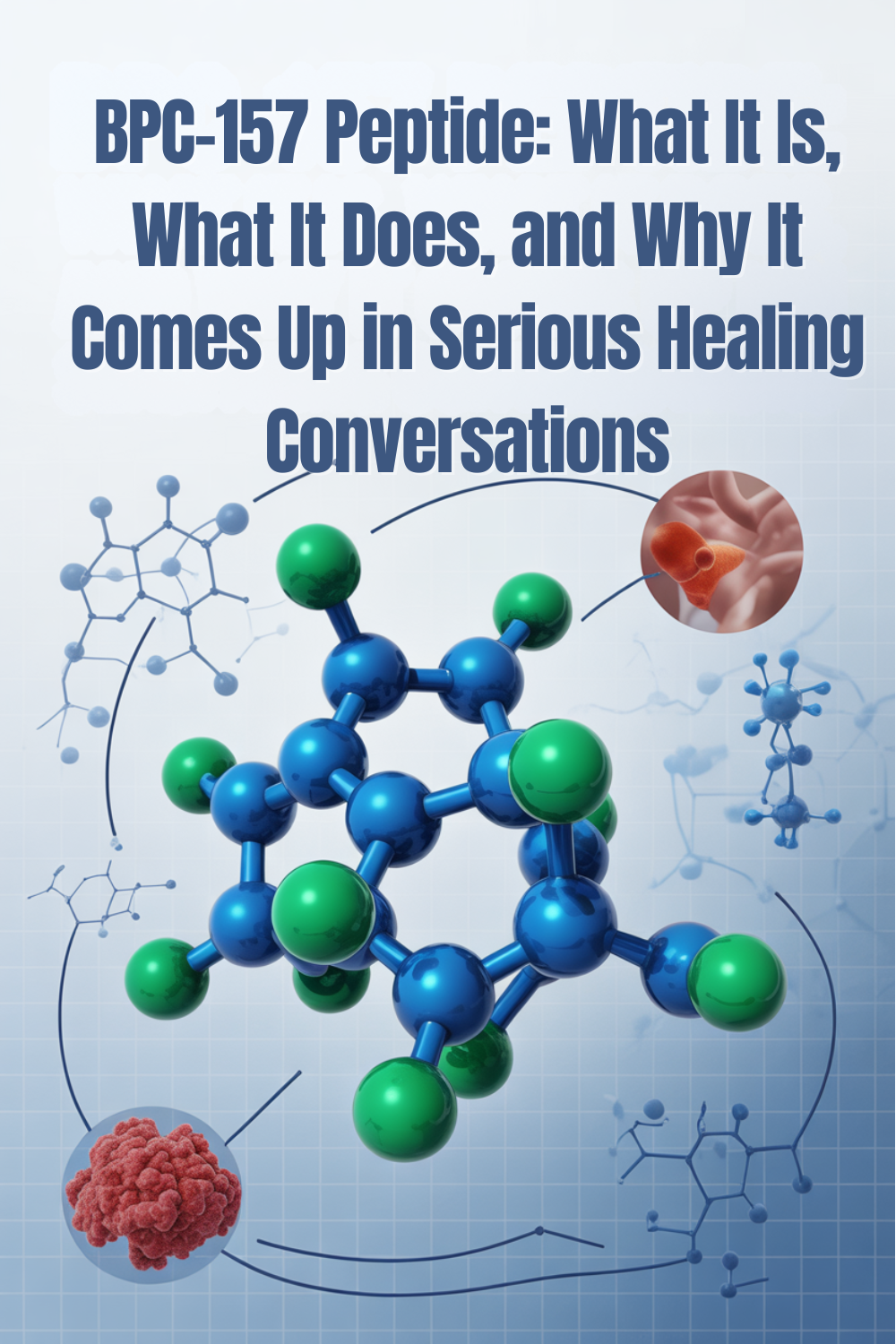
BPC-157 stands for Body Protection Compound-157. It is a 15-amino-acid peptide that was originally identified in research related to gastric juice and tissue protection. Early studies focused on how this peptide may help protect the lining of the digestive tract and support the body’s response to injury.
As research continued, interest expanded into how the BPC-157 peptide interacts with connective tissue, blood vessels, and inflammatory signaling pathways. Most available research comes from animal and laboratory studies rather than large human clinical trials. That distinction is important and often overlooked in online discussions.
Want to go deeper?
If you want to explore how BPC-157 is actually discussed in real-world healing conversations, including delivery forms, stability, storage, and practical decision-making, I cover that inside the paid membership.
The public conversation stops at education.
The deeper context belongs behind intention and responsibility.
👉 Join the membership to access the in-depth BPC-157 blog and the full peptide series.
What Does BPC-157 Do for Your Body?
Research interest around BPC-157 centers on how it may support the body’s natural repair and protection systems. Studies have explored its relationship to tissue healing, collagen formation, blood vessel signaling, and inflammatory modulation. These processes are foundational, especially for people dealing with chronic stress, injury, or long-standing dysfunction.
The BPC-157 peptide is also frequently discussed in relation to gut health. The integrity of the gastrointestinal lining plays a central role in immune signaling and nutrient absorption. When the gut barrier is compromised, the effects can ripple throughout the body. This connection helps explain why BPC-157 is often mentioned in holistic and integrative medicine conversations focused on foundational repair rather than quick fixes.
BPC-157 Benefits: What the Research Suggests
When people talk about BPC-157 benefits, they are usually referring to areas that have been explored in preclinical research. These include tissue protection, connective tissue support, modulation of inflammation signaling, and blood vessel repair pathways. These benefits are not guarantees, and they are not universal. They reflect areas of scientific interest rather than approved medical claims.
Understanding this difference helps keep expectations realistic and grounded. Promising research does not equal proven outcomes, especially when human data is limited.
What the Research Shows and What It Does Not
The research on BPC-157 is often described as promising but incomplete. Animal and cellular studies suggest it may influence healing pathways and regulatory signaling, but human clinical trials are sparse. Large-scale, long-term studies have not yet been completed.
This does not mean the peptide is ineffective. It means the science is still developing. Responsible education requires holding curiosity and restraint at the same time. Early research can guide exploration, but it does not replace rigorous human data.
BPC-157 Side Effects, Safety, and Regulatory Reality
BPC-157 is not approved by the FDA for medical use. It is generally classified as a research peptide, and long-term safety data in humans is limited. Reported side effects vary widely, and individual responses are not predictable.
Regulatory status also varies by country. In some regions, including Australia, BPC-157 is classified as a prescription-only or prohibited substance. This variability reinforces why education, legality, and sourcing matter when evaluating any peptide discussion.
Forms of BPC-157: Why Delivery Matters
BPC-157 is commonly discussed in several forms, including oral capsules, injectable preparations, and nasal sprays. Each form differs in stability, absorption, and handling requirements. These differences influence how the peptide behaves, which is why form matters more than many people realize.
At this level, it is enough to understand that not all forms are equivalent simply because they share the same name. Details matter, and those details require careful context.
BPC-157, TB-500, and Bodybuilding Conversations
BPC-157 is often mentioned alongside another peptide called TB-500. Both peptides are discussed in research and recovery circles because of their potential roles in tissue repair and inflammation signaling. They are structurally different and studied for different mechanisms, even though they are frequently grouped together online.
You will also see BPC-157 discussed in bodybuilding and sports medicine spaces. This is largely due to interest in recovery and tissue stress rather than performance enhancement. It is important to note that BPC-157 is not approved for athletic use and appears on prohibited substance lists in competitive sports.
Who This Conversation Is Really For
We are not starting from a healthy baseline as a population. Many people enter their healing journey already deeply inflamed, depleted, and dysregulated at multiple levels. In that reality, peptides and bioregulators should be discussed as practical tools within a modern healing framework.
Peptides are not replacements for nutrition, sleep, movement, or stress regulation. They can be used alongside those efforts, sometimes very early, to help stabilize systems that are already struggling. For individuals dealing with significant gut dysfunction, such as increased intestinal permeability, support at the level of cellular signaling may help the body respond more effectively as dietary and lifestyle changes are introduced.
This conversation is for people who recognize how compromised the modern body has become and are open to using intelligent, supportive tools to assist repair. Peptides and bioregulators are not shortcuts. They are resources that meet the body where it is and help restore forward momentum.
Want to go deeper?
If you want to explore how BPC-157 is actually discussed in real-world healing conversations, including delivery forms, stability, storage, and practical decision-making, I cover that inside the paid membership.
The public conversation stops at education.
The deeper context belongs behind intention and responsibility.
👉 Join the membership to access the in-depth BPC-157 blog and the full peptide series.
Closing Perspective
Peptides and bioregulators are not meant to replace the fundamentals of health like nutrition, movement, and sleep. But they also do not require those areas to be perfect before they can be considered. Healing does not happen in a straight line, and waiting for ideal conditions often keeps people stuck longer than necessary.
For many, peptides become supportive tools used alongside ongoing improvements in diet, exercise, and sleep, not after those foundations are flawless. By supporting communication and regulation at the cellular level, peptides and bioregulators may help the body respond more effectively as those lifestyle pieces are being strengthened in parallel.
There are growing reports and promising outcomes suggesting that peptides can support repair, recovery, and resilience in ways that feel additive rather than compensatory. They are not shortcuts, but they may serve as amplifiers, helping the body move forward while foundational habits continue to evolve.
This is not about bypassing the work. It is about recognizing that the body is dynamic and capable of responding to multiple forms of support at the same time. For some, peptides and bioregulators represent an untapped layer of healing that helps bridge the gap between improvement and true optimization.
Healing is not a race, but it also does not require perfection to begin. Sometimes the right signals, introduced thoughtfully, help the body remember how to finish what it started.
Jamie Shahan, MSN, CRNA, RN
Empowering Holistic Health
Curator of forgotten wisdom with a modern understanding of why it works.
🌐 Connect with me on Social Media:
Disclaimer
The information provided on this website, in associated blogs, courses, and materials, is for general educational and informational purposes only. It is not medical advice and should not be interpreted as such.
I am not a medical doctor. The content I share reflects my personal opinions, experiences, and research. It is not intended to diagnose, treat, cure, or prevent any disease, condition, or illness.
You should not rely on the information here as a substitute for professional medical care, advice, or treatment. Always consult with a licensed healthcare provider before making any decisions regarding your health, especially if you are pregnant, nursing, taking prescription medications, or managing a medical condition.
By reading this website or using any related materials, you acknowledge and agree that:
- You are fully responsible for your own health decisions.
- The author and publisher of this content assume no liability for any harm, loss, or adverse effects arising directly or indirectly from the use, misuse, or interpretation of the information provided.
- No guarantees are made regarding the outcomes of applying any ideas, suggestions, or protocols discussed. Results will vary for each individual.
Affiliate Disclosure
Some products or tools mentioned may include affiliate links. This means that if you choose to purchase through those links, I may earn a small commission at no extra cost to you. I only recommend products I have personally used, researched, or would recommend to someone I love.
Use at Your Own Risk
By accessing this website and its materials, you agree that you are doing so voluntarily and that you assume full responsibility for any decisions you make regarding your health, lifestyle, or purchases.