Bioregulators by System: What They Are and What They Support
Bioregulators are tissue-specific signaling peptides studied for how they support cellular communication and regulation within specific systems. This system-by-system guide explains what bioregulators are, how they differ from conventional approaches, and how to think about them intelligently.
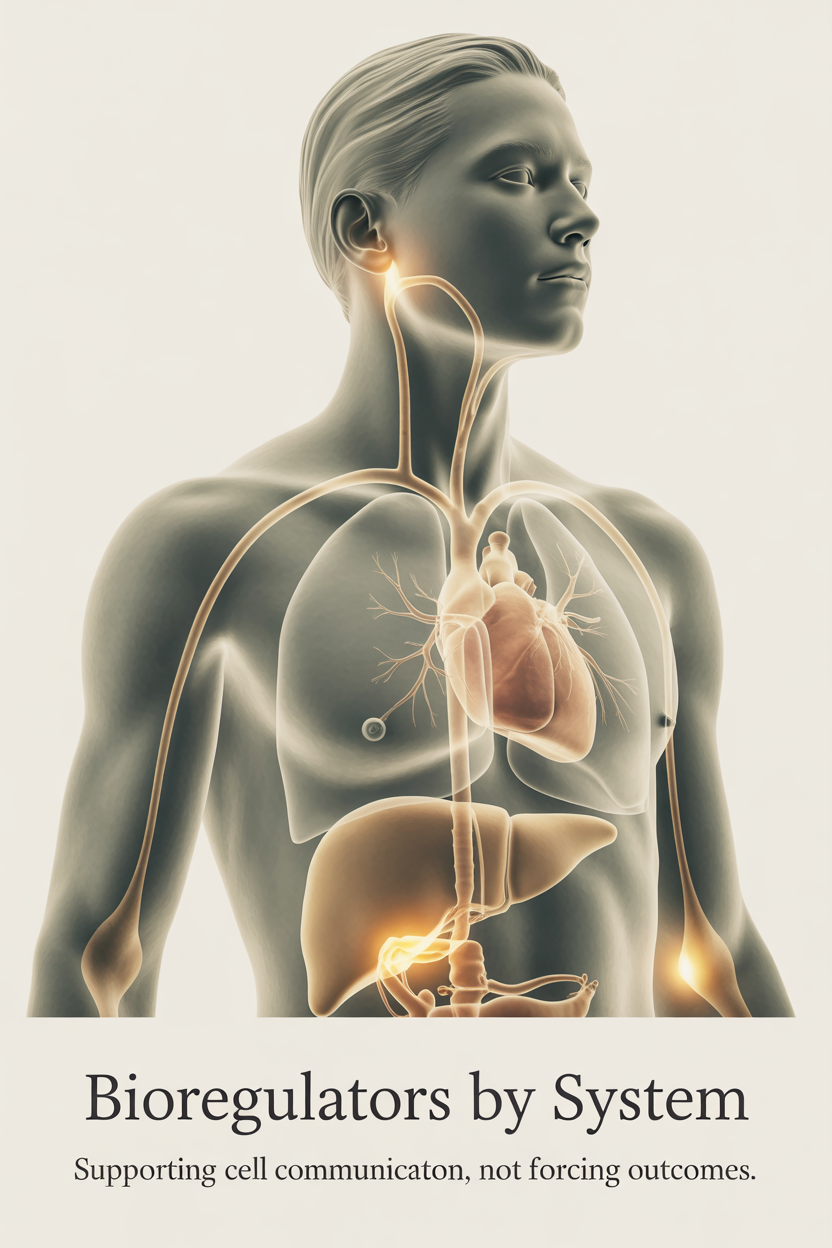
Bioregulators are often discussed as a concept, but where most people get stuck is here:
What are they actually used for?
Which systems do they support?
And how do they differ from conventional approaches that force outcomes?
The confusion is understandable, because bioregulators are not organized by symptoms. They are organized by systems.
One of the most helpful ways to understand bioregulators is to look at them by system. Bioregulators are tissue-specific signaling peptides. They are studied for how they support cellular communication, coordination, and regulation within a particular organ or system.
They are not medications.
They are not hormones.
They do not override symptoms.
They work by supporting how cells communicate with each other.
Below is a system-by-system overview.
Brain & Nervous System Bioregulators
These bioregulators support neuronal communication, repair signaling, and nervous system resilience, particularly as signaling changes with stress, inflammation, or aging.
Pinealon
Supports pineal gland function and circadian rhythm regulation. It is associated with melatonin signaling and neuroendocrine timing, helping coordinate sleep–wake cycles rather than forcing sedation or stimulation.
Cerebrolysin peptides
Support neuronal metabolism, neuroplasticity, and repair-related signaling within the brain. These peptides are studied for how they support brain resilience and recovery without acting as cognitive stimulants.
Cortexin peptides
Support cortical regulation, cognitive signaling, and adaptive stress responses within the brain. They are associated with clarity and nervous system resilience through regulation rather than forced neurotransmitter activity.
Epitalon (Epithalon)
Supports gene expression related to aging, circadian rhythm, and cellular repair through the pineal axis. It is studied for long-term regulatory effects rather than short-term neurological stimulation.
Cardiovascular & Vascular Bioregulators
These bioregulators support vascular integrity, endothelial communication, and coordinated heart tissue signaling.
Vasculin
Supports regulation of the vascular wall and endothelial signaling. It helps maintain communication within blood vessel tissues rather than altering blood pressure or vessel tone directly.
Cardiogen
Supports myocardial cell signaling and heart tissue repair processes. It is associated with tissue coordination and structural integrity rather than forcing heart rate or cardiac output.
Respiratory System Bioregulators
These bioregulators support lung tissue signaling, epithelial repair, and immune coordination within the respiratory system.
Bronchogen
Supports bronchial and lung epithelial tissue signaling and repair. It is studied for how it helps coordinate immune responses in respiratory tissues rather than suppressing symptoms or forcing airway dilation.
Immune & Thymus Bioregulators
These bioregulators focus on immune communication and balance, not immune stimulation.
Thymalin
Supports T-cell maturation and immune coordination signaling. It is associated with immune balance, particularly as immune regulation shifts with age.
Thymogen
Supports adaptive immune response signaling, helping the immune system respond appropriately rather than excessively or reactively.
Vilon
Supports immune cell differentiation and gene expression related to immune regulation. It is associated with long-term immune communication rather than acute immune activation.
Liver, Pancreas & Metabolic Bioregulators
These bioregulators support detoxification signaling, digestion, and metabolic coordination.
Hepatogen
Supports liver cell repair and detoxification-related signaling. It is associated with helping the liver coordinate responses during increased metabolic or toxic demand rather than forcing detox pathways.
Pancreagen
Supports pancreatic tissue regulation, digestive enzyme signaling, and glucose metabolism coordination. It focuses on tissue communication rather than stimulating insulin or enzyme release.
Musculoskeletal & Connective Tissue Bioregulators
These bioregulators support structural coordination and repair signaling, not forced growth or stimulation.
Cartalax
Supports cartilage metabolism and joint tissue repair signaling. It is associated with joint integrity and resilience rather than aggressive regeneration or inflammation suppression.
Chondramine peptides
Support connective tissue structure and joint signaling pathways. They help coordinate communication between cartilage, ligaments, and surrounding tissues rather than forcing repair responses.
Myogen
Supports skeletal muscle repair and metabolic signaling. It is associated with muscle adaptation and recovery through coordination, not stimulation or hypertrophy signaling.
Reproductive & Endocrine Bioregulators
These bioregulators support hormone-producing tissues rather than replacing hormones.
Ovariamin
Supports ovarian tissue signaling and reproductive regulation. It focuses on cellular communication within ovarian tissue rather than hormone replacement.
Testagen
Supports testicular tissue signaling and androgen balance pathways through tissue coordination rather than direct hormonal manipulation.
Gonadotropin-regulating peptides
Support communication along the hypothalamic–pituitary–gonadal axis. They help coordinate signaling between the brain and reproductive organs rather than forcing hormone output.
Pineal & Aging-Related Bioregulators
These bioregulators sit at the intersection of circadian rhythm regulation, aging, and cellular intelligence.
Epitalon / Pinealon combination
Supports telomere regulation, circadian coherence, and gene expression timing. These peptides are discussed in the context of long-term cellular regulation and resilience with aging rather than immediate effects.
How Bioregulators Work: Understanding System-Based Signaling
One of the most common mistakes people make is trying to choose a bioregulator based on symptoms alone. Bioregulators are typically discussed in the context of system stress, history, and long-term patterns, not isolated complaints. That is why education and context matter more than lists.
For this conversation to stay grounded and useful, a few distinctions are important. Bioregulators do not force outcomes, replace hormones, or override symptoms. Instead, they work by supporting cell-to-cell communication and helping tissues restore coordination on their own terms.
A helpful way to think about bioregulators is that they function more like instruction manuals than medications. They provide regulatory signals that help tissues remember how to coordinate their own function rather than pushing the body in a specific direction.
Because of this, their effects are often gradual and stabilizing rather than immediate or dramatic. That is not a weakness. It is the point. Bioregulators are most often explored by people interested in long-term regulation, resilience, and foundational support, rather than quick symptom suppression.
Seeing Bioregulators Through a System-Based Lens
Bioregulators are not about chasing symptoms or forcing change. They are about recognizing which system is asking for support and responding in a way that respects how the body actually works.
When bioregulators are viewed through a system-based lens, much of the noise drops away. The focus shifts from searching for a universal solution to understanding communication, coordination, and timing. That shift alone often changes how people approach their health.
This guide is not meant to tell you what to take. It is meant to help you understand how bioregulators are organized, what they are studied to support, and why they are used differently than conventional interventions. From that understanding, informed and intentional decisions become possible.
For many people, this system-based perspective becomes the foundation for exploring peptides and bioregulators in a more effective, thoughtful way.
Want to go deeper?
Inside The Restoration Library, I share deeper education on how I think about cellular communication, system prioritization, and how tools like bioregulators fit into a long-term, regulation-focused approach to health.
If you prefer understanding why something works before deciding whether it’s right for you, that’s where this conversation continues.
The Restoration Library
Jamie Shahan, MSN, CRNA, RN
Empowering Holistic Health
Curator of forgotten wisdom with a modern understanding of why it works.
🌐 Connect with me on Social Media:
Disclaimer
The information provided on this website, in associated blogs, courses, and materials, is for general educational and informational purposes only. It is not medical advice and should not be interpreted as such.
I am not a medical doctor. The content I share reflects my personal opinions, experiences, and research. It is not intended to diagnose, treat, cure, or prevent any disease, condition, or illness.
You should not rely on the information here as a substitute for professional medical care, advice, or treatment. Always consult with a licensed healthcare provider before making any decisions regarding your health, especially if you are pregnant, nursing, taking prescription medications, or managing a medical condition.
By reading this website or using any related materials, you acknowledge and agree that:
- You are fully responsible for your own health decisions.
- The author and publisher of this content assume no liability for any harm, loss, or adverse effects arising directly or indirectly from the use, misuse, or interpretation of the information provided.
- No guarantees are made regarding the outcomes of applying any ideas, suggestions, or protocols discussed. Results will vary for each individual.
Affiliate Disclosure
Some products or tools mentioned may include affiliate links. This means that if you choose to purchase through those links, I may earn a small commission at no extra cost to you. I only recommend products I have personally used, researched, or would recommend to someone I love.
Use at Your Own Risk
By accessing this website and its materials, you agree that you are doing so voluntarily and that you assume full responsibility for any decisions you make regarding your health, lifestyle, or purchases.